
Jor-MCP: The first MCP server for Brazilian journalism
Ambiental Media, an independent Brazilian media outlet, is developing open infrastructure so that newsrooms can make their content available to artificial intelligence systems on their own terms
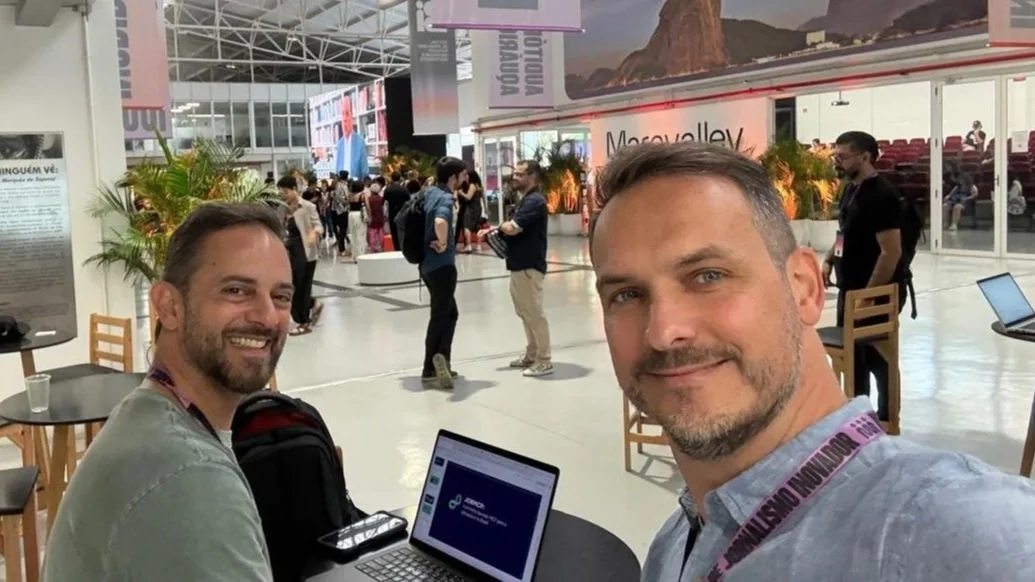
By: Sophia Linares and Thiago Medaglia, Ambiental Media
Editorial review: Miguel Vilela. Technical review: Jonas Rossi
In Brazil, no structured effort has been made to address a challenge that every news organisation in the world faces today: how do we govern the way artificial intelligence systems use our content? Language models read news stories to answer questions, summarise coverage, and power research agents — often with imprecise or fabricated results. Content produced by outlets committed to fact-checking, rigorous methodology, and data analysis ends up being used without attribution, a license, or compensation.
For a small climate journalism organisation, the answer was not to wait for solutions from the major platforms. Ambiental Media has long worked at the intersection of journalism, data, and technology — producing investigative reporting built on structured datasets, scientific evidence, and visual analysis. That work has been recognised internationally, most recently at the 2026 Sigma Awards — the leading global recognition for data journalism, organised by the Global Investigative Journalism Network — where our investigation into the Brazilian Cerrado was one of ten winning projects selected from 543 entries across 84 countries. In this context, the question we asked ourselves was: how could an independent newsroom position itself in the new era of AI, rather than simply remain on the sidelines?
Opportunities like the JournalismAI Innovation Challenge, supported by the Google News Initiative programme offer, beyond financial resources, a space to think through new solutions. Our team considered several approaches: an editing assistant focused on science and climate journalism, a platform for creating AI-assisted infographics, among other ideas. But it was from the dialogue between the journalists and tech team — something central to our newsroom's culture — that the winning proposal emerged.
Our lead engineer, Jonas Rossi, was the first to propose building a Model Context Protocol (MCP) server for journalism. MCP is an open standard proposed by Anthropic, now adopted by companies, research institutions, and public agencies around the world. Our executive director, Thiago Medaglia, developed the proposal further, including its name: Jor-MCP (from the Portuguese word “Jornalismo”).

Jonas Rossi, DevOps Engineer and Thiago Medaglia, Executive Director
An MCP server allows AI systems to access data in a structured way, directly from the source. Unlike a query to a web page — where AI must process menus, banners, scripts, and other noise — an MCP server like Jor-MCP delivers only the requested content, structured for machine consumption. The result is faster queries, lower token consumption, greater contextual accuracy, and the ability to include attribution metadata in the data delivered to AI clients.
The decision to apply this architecture to journalism stems from a harsh reality: the decline in web traffic and the erosion of click-based monetisation have left news organisations increasingly vulnerable. In this sense, Jor-MCP aligns with other international efforts to make the relationship between journalism and AI companies less unequal.
Pioneering initiatives, such as the MCP server from O'Reilly Media — developed by the Miso platform — suggest that this architecture is beginning to be tested in practice. With features such as user authentication, media outlets could gate access to their content based on verified accounts, paving the way for what some have called a "subscriptions for AI agents" model and enabling potential new sources of revenue.
As far as we know, there has not yet been a structured effort in this direction in Brazil (if we are mistaken, please write to contato@ambiental.media, we’d love to connect).
Unlike MCP servers geared toward research or fact-checking — which help journalists consult external databases — Jor-MCP is being designed so that media outlets can define on their own terms how they make their content available, in an effort to create a viable and structured alternative to informal data scraping.
The initial tests
A few months ago, our technical team — Lucas Alves in software engineering, Leonardo Santos Mosca in infrastructure and DevOps, and Rossi leading the effort — began research to map out the tools, techniques, and architecture of the MCP server. After the research phase, we built a proof of concept (PoC), which helped bring ideas to life and allowed for more precise course corrections. Some choices that seemed right "on paper" no longer made sense in practice.
A conversation with Abdullah Enes Gules, one of the creators of Context7 — an MCP designed to keep developer tools up to date — helped confirm a change in direction: we needed a lighter, stateless server, offering a limited number of tools, so that queries would consume less processing power. For small organisations, this matters considerably.
Today, in a test environment, the server already performs three operations: it searches for Ambiental content on our website and in our data repositories; it delivers the clean, structured text of a specific news article; and it lists the most recent published content, so that the AI agent always knows what is new.
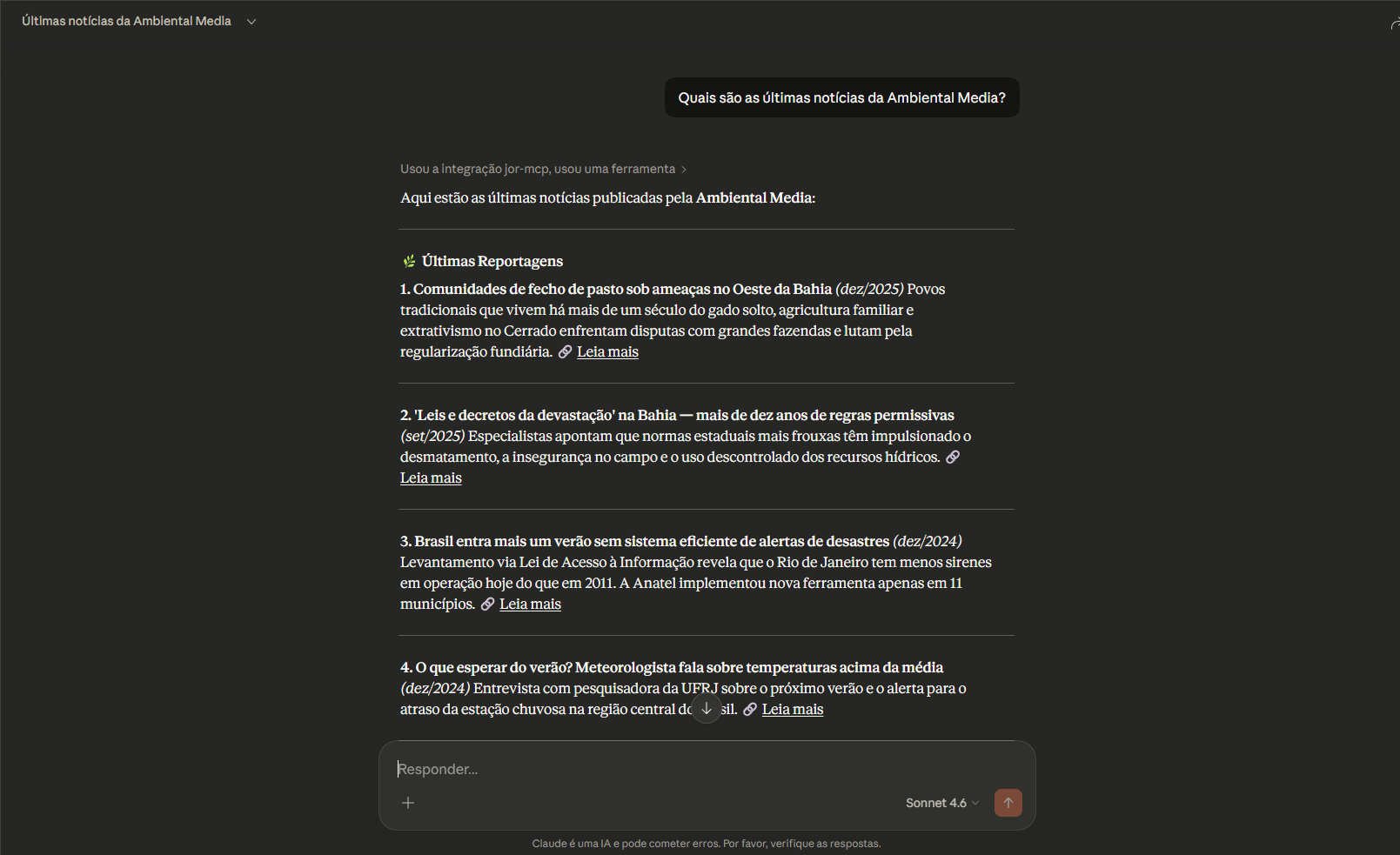
The next steps involve two-tiered testing: First, validation at Ambiental itself, using Jor-MCP in day-to-day operations to analyse what works and what needs adjustment; Next, replicability testing - we will verify whether a partner newsroom, using the code and documentation already refined through our real-world use, can get its own server up and running. These tests will determine whether the official public release, scheduled for November, moves forward as planned or requires additional iteration.
There is also the question of long-term community support. Jor-MCP is open source — each newsroom implements and maintains its own server, with its own terms of access. But how do we sustain the evolution of the code and documentation for the Jor-MCP user group? We are exploring options, in conversation with other organisations facing the same challenge in open-source tools for journalism.
For our own deployment of Jor-MCP at Ambiental, the model under discussion for financial sustainability resembles that of many AI services today: a free tier with a monthly query limit, and paid plans for those who require higher volumes. Access could be authenticated via OAuth — the same protocol used when you authorise an app to interact with your Google Drive account — and each connection would be tied to a plan and a usage limit. None of this has been finalised. These are early hypotheses on how the tool could, in the future, become an alternative source of funding for the organisation.

Our research will also yield a legal toolkit with sample terms of use and privacy policies, as well as a report on the possibilities for commercial use of Jor-MCP. On this last point, we plan to conduct in-depth research on current use cases of MCP servers, focusing on revenue-generating applications outside of journalism, and then, based on interviews and analysis, map potential paths that could apply to our ecosystem. The findings will be made public.
At this point, Jor-MCP is more a documented journey than a finished product. The code and documentation will be available on GitHub as an invitation to continue this conversation. We want other newsrooms to test it, find paths we have not yet imagined, and come back to share what they have discovered.
As we have done with ourinvestigations on the climate impacts of the expansion of data centers in Brazil, Ambiental Media is building Jor-MCP guided by the values that shape our journalism: rigor, transparency and public interest. We strongly believe that journalists must continue to investigate and report on AI. However, as the technical systems that influence how journalism is distributed, discovered and used by AI become increasingly central to the information ecosystem, journalism must also engage in the development of the infrastructures through which knowledge circulates.
_____
This article is part of a series providing updates from the second cohort of the JournalismAI Innovation Challenge, supported by the Google News Initiative. To read articles from our other grantees, click here.