
Amazônia Real does not take AI seriously, it takes it out to play
This Brazilian news agency is bridging the gap between investigative journalism and new audiences by transforming complex reports into interactive gamified experiences

From right to left, Eduardo Nunomura, Kátia Brasil and Alberto César Araújo, members of The Amazon Game project, and collaborators from the agency Nicolly Ambrosio and Hellen Lírtez, during a journalism congress in Brazil - Photo: Amazônia Real.
By: Eduardo Nunomura, Amazônia Real
I work with three different AI models and all of them are capable of writing honest, high quality texts, but everything you are about to read below was written by me. Not just because of the “human in the loop” approach, but out of certainty that they would not be faithful in this task. The Amazon Game is the fruit of human effort and the necessary distrust that is innate to us, but, without a doubt, with the providential help of machines. I will tell you exactly how.
On 10 February the independent investigative journalism agency Amazônia Real kicked off its journey in the JournalismAI Innovation Challenge, supported by the Google News Initiative, at the London School of Economics (LSE). For nine months, we are going to develop The Amazon Game, which transforms the dense and complex investigative reports published by the agency into a gamified experience. It is already an accessible reality at this address.

Eduardo Nunomura, coordinator of The Amazon Game, during a presentation of another project for the Google News Initiative Brazil, in 2025.
In our most optimistic forecast, a Minimum Viable Product (MVP) of The Amazon Game would only be ready in July. Efficiency? A stroke of luck? Teamwork? Yes, yes, and yes, but there is a fourth element that explains it better: vibe coding, that new strategy where the human dictates the rhythm, logic, and architecture in natural language, while the AI takes care of building the code.
In March, when the Amazônia Real team had already defined the product format, we ran into an unexpected problem. We could not find a workforce. We interviewed over 15 individual developers and software firms. Some had no notion of what journalism even is. Others charged between 60% and 70% of the project budget. And there were those who simply had no time to develop anything at all. Since I hold degrees in both computer science and journalism from the University of São Paulo in Brazil, I decided to build a simple prototype to show that our product was not something “out of this world”. It was meant to be a way to convince developers to join us on this journey. Rusty when it came to programming, I bet on the logic of vibe coding for this stage. I imagined it would be short-lived, something like playing around with Figma to create a beautiful, functional design, but with no real skeleton underneath. Within three weeks, I had something functional, which was far beyond just a prototype. I was just a few steps away from a real MVP.
The Amazon Game arose from a dilemma common to other media outlets: how to attract Generation Z to our content. In the classroom, years ago, I remember seeing students fascinated by gamified experiences from The New York Times, like Olympic Bodies. If an American newspaper could do it, why couldn’t an outlet that lives and breathes the Brazilian Amazon do it too? We had high quality material, over 4,000 text reports published by us, and the LSE team believing in our project: there were hundreds of applicants and only 12 selected worldwide. Weighing heavily in this selection was the track record of awards and prestige that Kátia Brasil and Elaíze Farias have achieved since they founded the agency back in 2013.
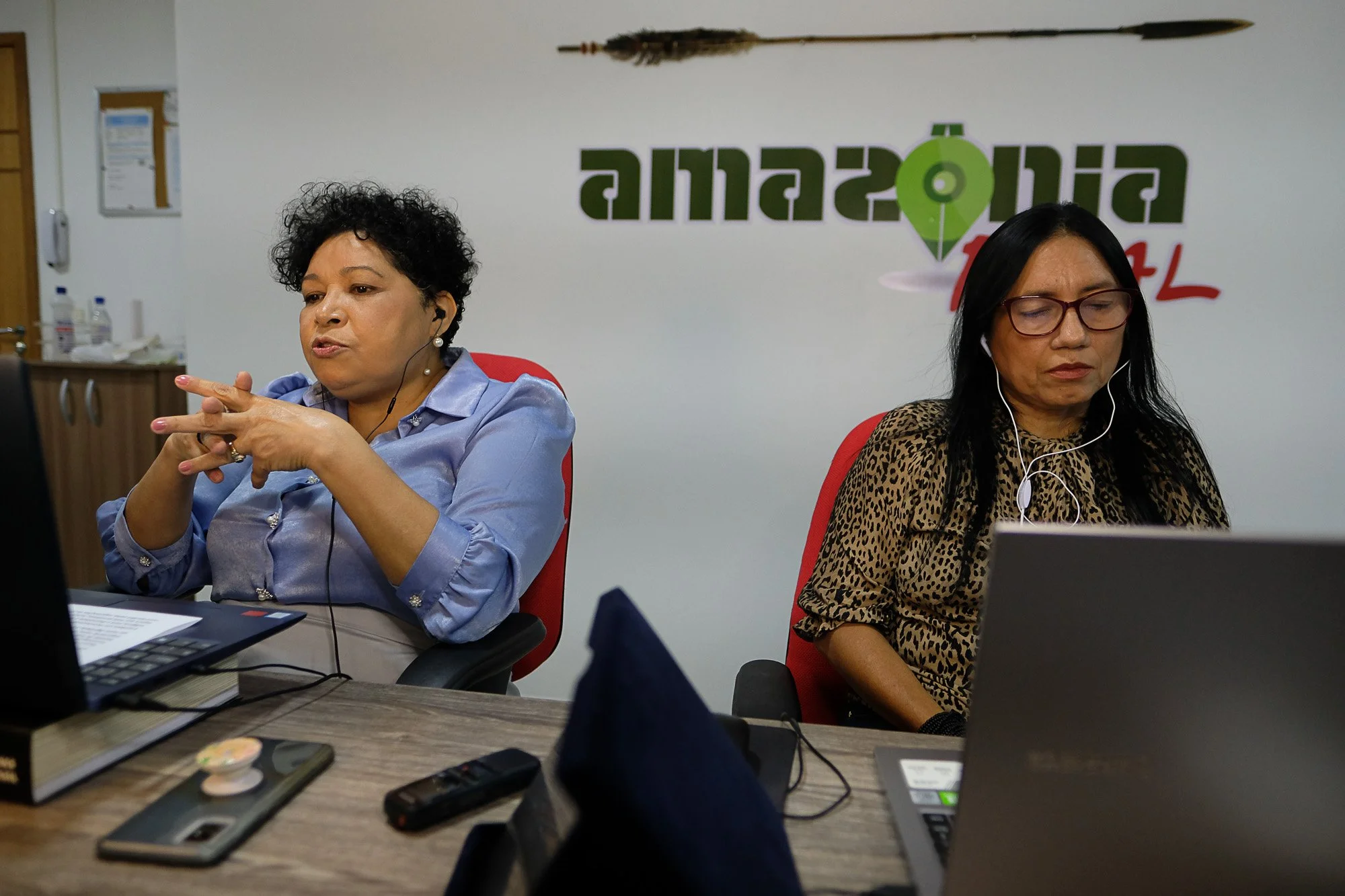
Kátia Brasil and Elaíze Farias, at the Amazônia Real office, in Manaus, Brazil - Photo: Leanderson Lima/Amazônia Real
Amazonian vibe coding
Amazônia Real is just getting started in the world of AI. We are distrustful, not outdated. We are well aware of initiatives that relied too heavily on technology and lost their grip on what they did best: believing in knowledge built collectively.
One of our suspicions stems from the high risk of hallucinations that Large Language Models (LLMs) produce regarding the tropical forest.
To reduce the probability of machine hallucinations, we researched and opted for Retrieval-Augmented Generation. RAG is an architecture that connects generative AI models to external data sources, such as organisational data from a company, an academic center, or specialised datasets. Everything is created around this baseline, which in our case represents nearly 15 years of narratives.
Along this journey, we were joined by the founders of Amazônia Real, Elaíze and Kátia, who reviewed the AI's questions and answers and eliminated clichés like “standing forest” (“floresta em pé”, in Portuguese) to refer to the Amazon. This phase of human in loop is fundamental for any vibe coding project. And also our Image Editor, Alberto César Araújo, responsible for selecting the photos that illustrate our first version of the game and thinking through the user experience alongside me.
In May, with an audience of over 80 freshmen at the Faculdade Cásper Líbero, where I teach journalism, I conducted a beta testing session and the two data points that truly mattered: 96% of students reported learning something entirely new about the Amazon, and an average of over 5 minutes per session, with peaks of up to 10 minutes. That is more than triple the average dwell time on the main Amazônia Real website. For a region as systematically misrepresented as the tropical forest, that 96% is not a vanity metric, but it is the whole point.

Future challenges
We are sure that The Amazon Game will be the first in a series of gamified experiences that we plan to adopt. This is because the project, which runs through October, dictates the creation of an open source plugin for WordPress. This means our intention is to offer, entirely for free, a technological solution for any journalistic outlet to create similar gamified versions based on their own content. The decision to provide a tool for other companies is, in itself, a political act.
Even though AI models are products of big tech companies who are greedy for profits, Amazônia Real believes in shared knowledge. What would be the value of creating a product just for ourselves?
The road to the finish line appears arduous for reasons that anyone today can understand. Every massive technological tool has to be plug and play style. If our product forces a user (journalist) to type a single command like “git commit -am "Update existing layout styles"”, it means we have failed, 100%.
Many newsrooms and journalism itself were left behind in the digital race because there were a lot of barriers to entry. This has happened since the dawn of Gutenberg's printing press, moved through the arrival of computers in newsrooms, and hit radically with the internet, when older generations were left responsible for making the transition from analog to digital, and we all saw how that turned out. And now comes AI to tear down all these apparent obstacles, creating tools for viral proliferation across society.
Recently, in a conversation with the Brazilian philosopher Leandro Karnal (one of the country's most popular intellectuals), Claude.ai stated something we should all pause to think about: “The typewriter did not do the thinking for Clarice Lispector [a wonderful Brazilian writer]. That is the difference you are about to forget”. Obviously, we at Amazônia Real have not forgotten, because only with good information will future generations help take care of the planet.
Final words: I said, in the beginning of this text, everything would be written by me, in my native language of Portuguese, except, of course, for this entire translation to English.
_____
This article is part of a series providing updates from the second cohort of the JournalismAI Innovation Challenge, supported by the Google News Initiative. To read articles from our other grantees, click here.