
Introducing the JournalismAI Academy for APAC cohort
Our largest APAC cohort yet brings together journalists, editors, and newsroom leaders from across the region
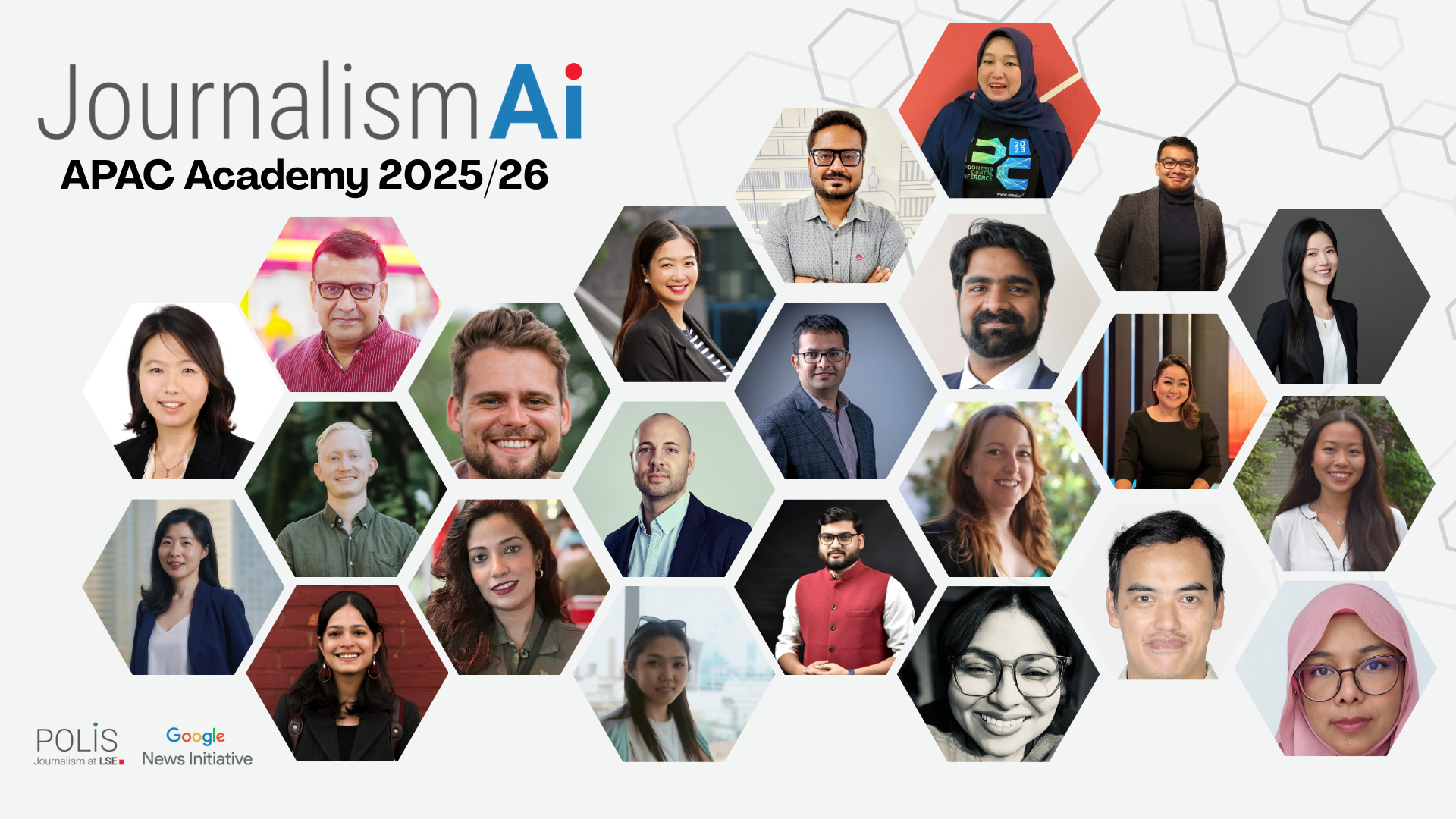
Asia-Pacific is home to some of the most dynamic and challenging media environments. Newsrooms in the region operate under very different conditions, but across the board, there's growing interest in what AI can do for journalism, and a shared recognition that figuring out how to use it well is no longer optional.
That's the backdrop for the 2025/26 edition of the JournalismAI Academy. Over the next five weeks, participants from across Asia-Pacific will learn how AI can support their newsroom workflows, strengthen their journalism, and help them navigate the challenges specific to their corners of the region.
Over 150 submissions came in from newsrooms of all sizes and shapes. Selecting the final group was a challenge. We usually accept 20 participants, but this time, we couldn't justify turning away three additional applicants who were too strong to pass up. The result is our largest Academy for APAC cohort yet.
What stands out about this group is where they sit within their organisations. These are editors, news directors, digital leads, product managers, and senior journalists, people whose roles give them real influence over how their newsrooms operate.
The cohort represents newsrooms from across the region, with some working at major national outlets. Others are at smaller operations doing critical public-interest journalism with limited resources. Many serve multilingual audiences and communities where access to reliable information is anything but guaranteed.
What the applications told us
Reading through the applications gives you a snapshot of what's on the minds of journalists across the region. A few themes came up.
Misinformation is everywhere, and it's getting harder to fight. This was, by far, the most common concern. Applicants described struggling to verify information quickly, tracking false claims across platforms, and watching AI-generated content, including deepfakes, spread faster than they can debunk it.
Data journalism is a growing priority. Applicants want to do more ambitious investigative work, analysing large datasets, extracting patterns from public records and financial documents, and finding stories that would be impossible to spot manually.
There's a strong focus on local and regional journalism. Many applicants are committed to covering communities that are often overlooked, whether that's provincial politics in South Asia, environmental stories in the Pacific Islands, or underreported social issues across Southeast Asia. For these journalists, AI isn't about scale for its own sake. It's about reaching audiences who need reliable information but often lack access to it.
A region in motion
According to BCG's annual AI at work survey, APAC employees are using AI more and are more optimistic about its potential than the rest of the world. In countries like India, adoption rates are as high as 92%. In Japan, it's closer to 50%. The picture is uneven, and so are the anxieties, with employees in the region also more likely to worry about job displacement than their global peers.
For newsrooms, this creates both pressure and opportunity. Some are already building sophisticated AI tools and integrating them into daily workflows. Others are watching, learning, and trying to figure out what makes sense for their own resources and audiences.
This cohort sits right in the middle of that conversation. Over the next five weeks, they'll learn from experts, share what's working (and what isn't) in their own newsrooms, and build action plans they can take back to their news organisations. .
Meet the participants
🇦🇺 Australia
Flip Prior | Audience Projects Lead, ABC Investigative Journalism and Current Affairs at Australian Broadcasting Corporation
Scott Purcell | Co-founder at Man of Many
Steven Mew | News Lead at The Australian Science Media Centre
🇭🇰 Hong Kong
Martin Goillandeau | News producer, video at CNN
Soo Jin Kim | Digital Editor, APAC at Bloomberg News
🇮🇳 India
Aditya Dwivedi | News Editor at Dainik Bhaskar
Anoushka Dalmia | Deputy Editor at Asian Dispatch
Bal Krishna | Senior Executive Editor - Fact Check at India Today Group
Subhasish Dutta | Executive Editor at Jagran New Media
🇮🇩 Indonesia
Iman Abdurrahman | Program Coordinator at Mata Iklim
Mochamad Alvin Dwiana Qobulsyah | Managing Editor at The Southeast Asia Desk
Betty Herlina | Journalist and Founder at Bincang Perempuan
🇲🇾 Malaysia
Sakina Mohamed | Editor at BERNAMA (The Malaysian National News Agency)
🇲🇳 Mongolia
Egiimaa Tsolmonbaatar | Head of Research and Data at Mongolian Center for Investigative Reporters (MCIR)
🇳🇵Nepal
Rajneesh Bhandari | Chief Editor at Nepal Investigative Multimedia Journalism Network
🇳🇿 New Zealand
Carla Teng-Westergaard | Media Adviser at Asia Media Centre
Carmelita Mentor-Fredericks | Digital Editor at Farmers Weekly NZ
🇵🇰 Pakistan
Sana Jamil | Digital Editor, English News at Interlink Multi Media
🇵🇭 Philippines
Regina Hing | Senior Anchor and Business Editor at One News
🇰🇷 South Korea:
Haeran Hyun | Journalist at Yonhap News Agency
Shreyas Reddy | Lead Correspondent at NK News
🇹🇼 Taiwan
Fiona Chou | AI Enablement and Transformation VP at CommonWealth Magazine
🇹🇭 Thailand
Haruka Nuga | Southeast Asia News Director at The Associated Press
Meet the instructors
Aaqib Raza Khan, Deputy Editor, Product & Content Innovation, NDTV, one of India’s leading broadcast and digital news organisations, will be teaching Module 1: Understanding AI & Its Applications.
Kuek Ser Kuang Keng, Data Editor at Pulitzer Center on Crisis Reporting & Founder of Data-N, a customised and affordable Data Journalism training package for newsrooms. He will be teaching Module 2: Data & technology.
Jaemark Tordecilla, Journalist, media advisor, and technologist, who has worked with dozens of newsrooms around the world on AI systems and newsroom innovation. He will be teaching Module 3: Generative AI for journalism: Best Uses.
Joanne Kuai, Research Fellow at the School of Media and Communication, RMIT University, Australia, holds a PhD from Karlstad University, Sweden. She will be teaching Module 4: Risks & concerns.
Sannuta Raghu, Head of AI Lab, Scroll Media Inc and, is an award-winning Indian journalist. She will be leading Module 5: From Ideation to Implementation.
Follow the participants' progress by connecting with us on LinkedIn, BlueSky, and X.
