
Ambiental Media: Rethinking news distribution in the AI era
Project name: Jor-MCP
Newsroom: Ambiental Media (Brazil)
Solution: Open-source Model Context Protocol server delivering structured, journalism with source attribution
Organisation staff size: 10 - 20
Tech stack: FastMCP, Python, Google Cloud Run, OAuth 2.1, GitHub Actions
Impact: Launched open-source infrastructure for newsroom-controlled AI access, independently adopted, with B2B models under exploration
Core lesson: Build distribution channels at the infrastructure level to set the terms on which AI accesses news content
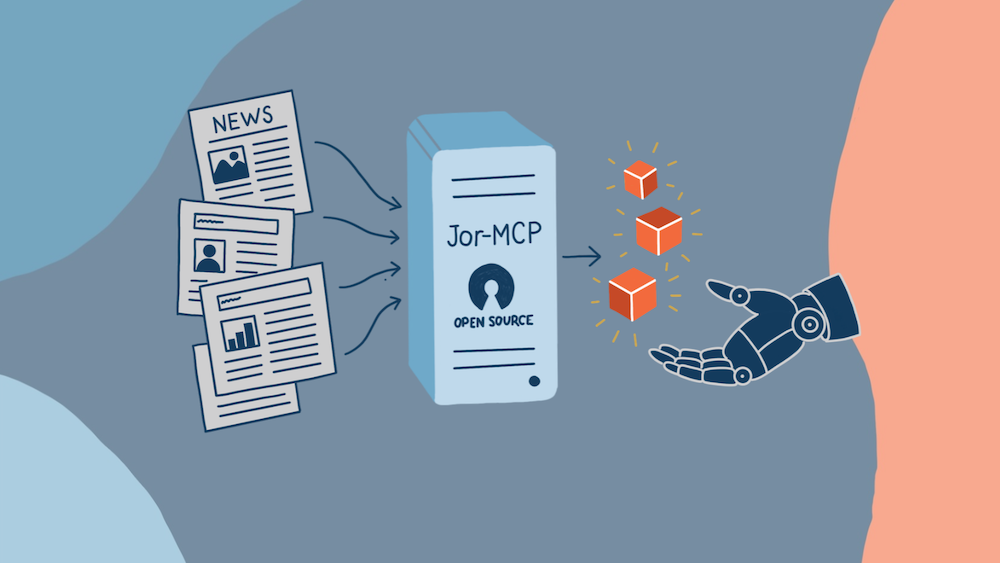
Brazilian non-profit newsroom Ambiental Media developed Jor-MCP server designed to deliver structured journalistic data directly to AI agents. Jor-MCP enables independent media organisations to set the terms on which content is accessed, preserve attribution, and explore new B2B subscription models for AI agents.
The problem: Protecting independent journalism in an AI-driven media landscape
Many independent publishers face two pressures: declining traditional revenue streams and growing concerns over how generative AI tools ingest, summarise, attribute and compensate them for their reporting. For niche independent newsrooms like Ambiental Media, specialising in science and data-driven investigative journalism, this environment threatens long-term financial self-reliance and content control.
As executive director Thiago Medaglia notes, the shift in how audiences discover news presents a fundamental challenge to independent newsrooms: "I think AI brings a new set of challenges in terms of where people will be consuming their news and we are trying to be ahead in the conversation that's why we created Jor-MCP."
Building the solution: Developing Jor-MCP
To tackle this challenge, Ambiental Media built Jor-MCP (Jor being short for the Portuguese word “Jornalismo”), an open-source MCP server designed to let media outlets serve clean, structured data directly to AI agents on their own terms.
Proposed by lead DevOps engineer Jonas Rossi and developed alongside technical team members Lucas Alves (software engineering) and Leonardo Santos Mosca (infrastructure/DevOps), Jor-MCP acts as a standardised data connector. The team initially built and validated a proof of concept (PoC) using FastMCP, Python, and Google Cloud Run. Based on this PoC, they established initial architecture documentation, including information flow diagrams, component diagrams, and technical specifications, and structured the open-source repository with CI/CD automation pipelines via GitHub Actions.
Specialised technical mentorship from Abdullah Enes Gules (Context7) guided key architectural decisions, such as adopting a lightweight, stateless architecture, implementing OAuth 2.1 for secure authentication, and reducing exposed tools to minimise AI query processing power and costs. The server connects to content management systems and data repositories like GitHub to deliver structured data, and the project is aiming for an official public release in November 2026 following validation and partner replicability testing.
Rossi explains the core technical motivation behind establishing a direct protocol interface for AI clients rather than relying on traditional web crawling: "AI agents right now are capable of doing the web search and the web scraping but... this is not efficient. This is not even the best way because of the amount of programmatic data that comes together with a web search... That's why Anthropic created the MCP protocol to serve clean and short and straightforward data to AI agents."
The opportunities: Monetisation, attribution, and AI agent distribution
Jor-MCP creates strategic opportunities for independent media by positioning newsrooms at the infrastructure level of the AI ecosystem. As public content consumption shifts from traditional web browsing to direct queries with AI agents, MCP servers offer a standardised method to preserve attribution, deliver accurate data and maintain source integrity.. Furthermore, Jor-MCP opens pathways for monetisation and financial self-reliance.
Medaglia emphasises the potential for long-term sustainability through infrastructure control: "I think Jor-MCP is the best product or the best tool that we have developed so far in terms of the possibility of turning it into something that could bring revenue to the organisation... once media organisations focus on developing their own infrastructure that puts you in a different position to have conversations."
Lessons for newsrooms
Engage at the infrastructure level: Rather than waiting for major tech platforms to establish rules, news organisations should actively build and control the technical distribution channels through which their content reaches AI models.
Foster interdisciplinary collaboration: Close, ongoing collaboration between editorial leaders, data journalists, and software engineers is crucial for identifying emerging technological standards and translating them into newsroom solutions.
Prioritise open source and replicability: Developing lightweight, open-source solutions with comprehensive technical, operational, and legal toolkits empowers smaller partner newsrooms to replicate technology and collectively strengthen independent media ecosystems.
Seek technical mentorship early: When adopting cutting-edge technology protocols, reaching out to established community developers for mentorship significantly accelerates development.
Provide open legal and operational toolkits: To facilitate adoption across newsrooms, technical solutions should be accompanied by comprehensive resources, including sample terms of use, privacy policies, and reports detailing commercial possibilities.
Explore case studies from the 2025 cohort
The 2025 Innovation Challenge Report, Prompting Sustainability, collects case studies from all 12 grantees and reveals their journeys, challenges, and opportunities.
Read about their experiences, discover best practices, and find inspiration in their innovative approaches to integrating AI into journalism.