

Public Policy: Using AI to connect parliamentary reporting with the public record
Project name: Postilla AI
Newsroom: Public Policy (Italy)
Solution: An entity-resolution system linking parliamentary reporting directly to official public records and ontologies
Organisation staff size: 10 - 20 staff
Tech stack: Entity extraction models, Italian Parliament public knowledge graph, institutional database connectors
Impact: Improved research speed for reporters and enhanced civic transparency for subscription clients
Core lesson: Build entity-based extraction models rather than searching by whole articles to achieve consistent database matching
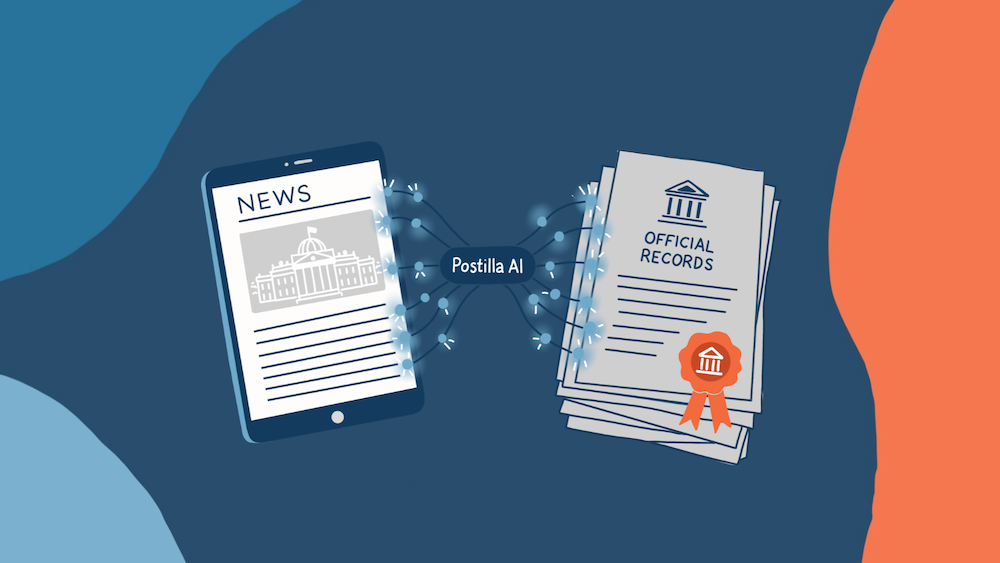
Every day, Italian news agency Public Policy files between 200 and 250 news items from inside the institutions of Rome and Brussels. Each captures a moment in a much longer story, recorded in official documents that few people ever read. The agency set out to build Postilla AI, named after the Italian word for a note in a text's margin: a system that uses AI to link its live coverage to the institutional records behind it.
The problem: More public information than any newsroom can read
Public Policy was founded in 2012 as a journalistic start-up, applying the news agency model to a neglected beat: Italy's parliamentary committees, where the technical debate on legislation actually happens.
“We discovered that the old model of the news agency, live newswire and direct reporting, was actually pretty modern and suitable for this kind of journalistic work,” says Leopoldo Papi, co-founder and Editor-in-Chief.
Today it follows the whole policymaking process in Italy and, through Public Policy Europe, in Brussels. It is a business-to-business service funded by subscriptions, with around 100 major clients, from Italy's Parliament and government to corporates, trade unions, NGOs and UN agencies.
Yet institutions produce far more information than reporters can process. Committee transcripts, bills, amendments and parliamentary questions are public and free, but scattered across complex databases. “There is a huge amount that, even with a huge team of journalists, you wouldn't be able to analyse,” Papi says.
In early 2025, the agency began building an in-house digital team. “The world is changing fast with this AI revolution, and we really felt that we were falling behind,” Papi says.
The idea for Postilla AI was already on the table when the team came across the JournalismAI Innovation Challenge. For a small organisation with limited resources, the grant “gave us the push and the opportunity to really dive into this problem,” Papi recalls.
Building the solution: From articles to entities
Postilla AI was designed to support reporting, not replace it: in Papi's words, “tools for our journalists, and perhaps even tools to give footnotes to our newswire.”
The first approach searched institutional databases for documents related to each newswire item. But articles vary enormously, and many, such as a brief item on a vote, have no documents worth retrieving. “It could be disappointing,” Papi admits.
So the team pivoted. Postilla AI now uses AI to perform entity resolution across Public Policy's archive, identifying the people, roles, bills, parliamentary acts and institutions mentioned in each piece, such as a committee chair or a bill's rapporteur.
“Every article has its own specific context. Meanwhile, the entities are always the same,” Papi explains. “So we can train our AI agents to work on the entities and find relevant external documents related to them and to the topic.”
Nicola Squartini, Chief Technology Officer, describes how it works: an OpenAI model first extracts the key entities from Public Policy's articles, such as politicians, political parties, institutions and legislative acts. Entity-linking techniques then match them with their records in the public knowledge graphs of the Chamber of Deputies and the Senate, using SPARQL queries over RDF data.
Still experimental, the system has no interface yet and must be run by engineers. “For us it's really an engineering problem,” Papi says.
“The biggest technical challenge has been reliably matching entities mentioned in news articles with their official counterparts, particularly when names are ambiguous or institutional data is incomplete,” says Squartini. “Our first working version already demonstrates the viability of this approach, but we still need to improve the accuracy and robustness of the matching process before making the system accessible through a user interface.”
The opportunities: Context for reporters and readers
When an entity is a politician, Postilla AI can surface their record on a topic: questions tabled, bills steered as rapporteur, remarks in debates. When it is a parliamentary act, it can link straight to the document. “That improves transparency, because you have a direct link from the reporting to the actual source,” Papi says.
The team sees two uses. In the newsroom, research tools built into Public Policy's editorial system would let journalists pull documents and references from institutional databases as they write. For readers, names in articles could become clickable, opening a side panel with context from official sources, much as Dow Jones' Factiva does.
Reporters, though cautious about technology, have already welcomed the agency's new platform, where AI summarises the stream of short updates.
“We are not at the level of Reuters,” Papi says. “But by trying to be clever and smart, we can do a lot.”
Lessons for newsrooms
Build around entities, not articles: Articles are too varied for AI to handle consistently, while people, bills and institutions stay the same, and the open ontologies institutions publish already map how they connect. “It could be applied by any newsroom,” says Papi. This same logic would apply to any internal metadata, to provide consistency and context.
Relevance is the hardest part: Every user, and every journalist, is looking for something different. Challenges arise at every layer, from database analysis to search and interface design. Contextual prompting is key to ensure results that are highly relevant to the individual use case and base data.
Treat it as research: Framing Postilla AI as research rather than a product let the team learn from its mistakes. “Once you have found a way to apply AI to the analysis of these databases, you can develop editorial tools and also context tools for your reporting,” Papi says.
Anchor AI in official data: “Start with authoritative, structured data rather than relying on AI alone,” says Squartini. “Institutional knowledge graphs provide the foundation, while AI helps bridge the gap with journalism.”
Explore case studies from the 2025 cohort
The 2025 Innovation Challenge Report, Prompting Sustainability, collects case studies from all 12 grantees and reveals their journeys, challenges, and opportunities.
Read about their experiences, discover best practices, and find inspiration in their innovative approaches to integrating AI into journalism.
The JournalismAI Innovation Challenge, supported by the Google News Initiative, is organised by the JournalismAI team at Polis – the journalism think-tank at the London School of Economics and Political Science, and it is powered by the Google News Initiative.
