

Rappler: Building an AI-led reader engagement ecosystem
Project name: Mira (My Intelligent Reader Assistant)
Newsroom: Rappler (Philippines)
Solution: Embedded AI suite providing article summaries, archive contextualisation, and seamless story navigation
Organisation staff size: 51 - 100 staff
Tech stack: Rappler Knowledge Graph, contextual recommendation engine, custom CMS integration
Impact: Improved content discovery and reader engagement and retention by making historical reporting and story context directly accessible
Core lesson: Ground AI development in user research, editorial workflows, and continuous measurement
Rappler is an independent digital newsroom in the Philippines. Its audience research revealed that while readers come to the publication with an interest in specific stories, their journeys often end after reading a single article.
Around 85 per cent of visitor sessions end after one page, despite half of these sessions reaching a quality read. At the same time, 68 per cent of surveyed readers said they often or always need additional context when reading complex stories, and 54 per cent leave Rappler to look for that context elsewhere.
“These findings highlight an important opportunity: readers were not necessarily disengaged from our journalism, but our existing experience did not always make it easy for them to discover related reporting, understand the broader context, or follow developments over time,” said Patrisha Estrada, Data Science Lead at Rappler.
The problem: Discovering related reporting
When they applied to the JournalismAI Innovation Challenge, Rappler was actively exploring how AI could strengthen its journalism and relationship with audiences.
At the time, they had already begun developing AI-powered recommendation systems and other initiatives to better utilise their existing editorial and data assets, including their extensive archive, growing network of topic pages, and AI-powered products. The JournalismAI Innovation Challenge presented an opportunity to connect these initiatives more intentionally.
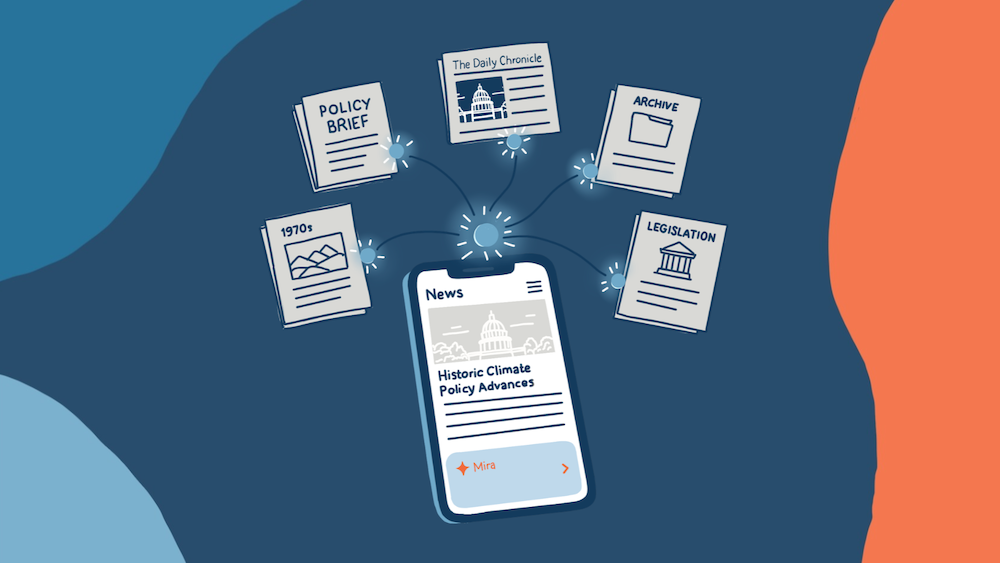
“Rather than develop another standalone AI tool, we envisioned Mira (My Intelligent Reader Assistant) as an integrated layer within Rappler's broader product ecosystem. Through Mira, we aimed to rethink how we recirculate our journalism, surface relevant context, and make our accumulated knowledge more accessible and useful to readers,” explained Estrada.
Building the solution: An interconnected reader assistant
Mira is a collection of AI-assisted features embedded directly into Rappler's article pages, designed to help readers better understand the stories they encounter and discover relevant journalism beyond the article they are reading. Mira's internal-facing features are accessible to users with access to Rappler's CMS.
The solution currently includes three live features:
Content Summary provides AI-generated summaries of articles, allowing readers to quickly grasp the key points of a story.
Context Summary provides additional historical background and information that may not be explicitly covered in the article. Powered by Rappler's knowledge graph, it connects current stories to relevant past reporting and directs readers to related articles from its archive.
Swipe allows readers to seamlessly navigate to the next recommended article without scrolling to traditional recommendation modules. It builds on its existing contextual recommender system, which is also powered by AI.
“Together, these features make use of Rappler's existing AI and data infrastructure to create a more connected reading experience. We are also developing Topic Follow, which will allow readers to follow issues they care about and stay updated on developing stories,” said Estrada.
Mira is developed by a cross-functional team of approximately 17 people, bringing together expertise from Rappler's technology, data science, editorial, audience management, creative, and grants teams.
The opportunity: Building workflows that reflect organisational ethos
“We wanted Mira to fit naturally into established newsroom workflows. Rather than introduce another tool for editors to learn, we integrated its features directly into our existing CMS to encourage adoption and minimise disruption,” shared Estrada.
They also ensured that AI-generated content undergoes human review, consistent with Rappler's AI guidelines, which emphasise editorial accountability, transparency, and verification, added Estrada.
The organisation’s audience research played a significant role in determining both feature prioritisation and implementation. Findings on readers' need for context and their preference for concise, structured information informed their decision to focus on AI-generated summaries rather than conversational interfaces. They also revisited existing capabilities, such as Content Summary, and introduced Swipe to make it easier for readers to continue exploring relevant stories without scrolling through an entire article.
They also deliberately built on Rappler's existing AI infrastructure and recommendation systems.
“Our goal was not to create siloed products, but to develop an interconnected ecosystem that maximises the value of our existing data, technology, and editorial assets,” explained Estrada.
“We also adopted an iterative development approach, refining our plans as research findings, technical considerations, and other organisational initiatives evolved. This allowed us to roll out features incrementally while continuing to improve the overall reader experience.”
Lessons for other newsrooms
Ground product decisions in research and continuous measurement: Audience research helps validate assumptions and refine solutions, while early analytics implementation ensures we can measure impact and continuously improve.
Integrate AI into existing workflows, with editorial teams involved from the start: Integrating AI into existing workflows requires close collaboration to balance automation with editorial oversight, accuracy, and accountability.
Build iteratively, but manage scope deliberately: Incremental releases allow teams to deliver value, learn from actual usage, and adapt quickly, while maintaining a clear scope prevents unnecessary delays.
Explore case studies from the 2025 cohort
The 2025 Innovation Challenge Report, Prompting Sustainability, collects case studies from all 12 grantees and reveals their journeys, challenges, and opportunities.
Read about their experiences, discover best practices, and find inspiration in their innovative approaches to integrating AI into journalism.
The JournalismAI Innovation Challenge, supported by the Google News Initiative, is organised by the JournalismAI team at Polis – the journalism think-tank at the London School of Economics and Political Science, and it is powered by the Google News Initiative.
