
Civio is building an AI agent for donor management. Its first rule: the data never leaves the office
Read how a small Spanish investigative non-profit newsroom is teaching a local AI agent to navigate 14 years of messy donor operations
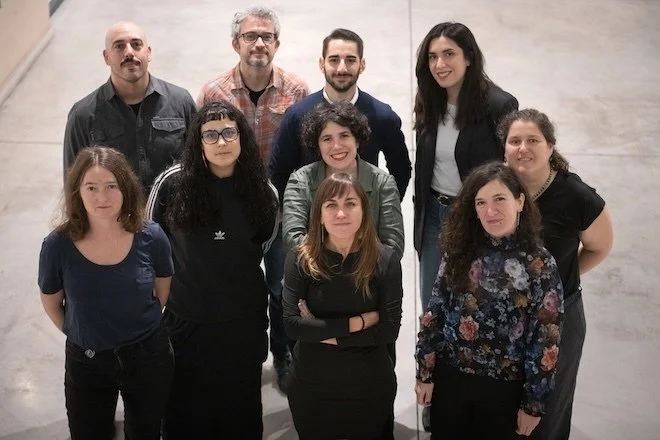
The Civio team in Madrid. Photo: Fernando Sánchez
By: Javier de Vega, Civio
At Civio, a Madrid-based nonprofit dedicated to investigative journalism and public accountability, roughly half our revenue comes from over 2,300 small donors. People who believe in what we do and put their money behind it: €5 a month, €70 a year, a one-off €10.Managing those relationships well isn't optional for us. It's existential.
Like many small newsrooms, our donor management has grown organically over 14 years. Payment data lives in Stripe; email engagement, in Mailchimp; donor notes and history, in a custom CRM we built long ago. And a lot of critical knowledge lives in the heads of specific team members: who called last week about a billing issue, who mentioned they want to increase their contribution, who needs a tax certificate before the fiscal year ends.
When a member writes in to update their bank details or postal address, to say they'd rather skip the welcome gift, or to pay for a membership as a present for someone else, answering even simple requests means juggling three admin panels, re-entering the same details in each one, and double-checking that nothing slips through. If the colleague who usually handles that kind of request happens to be away, things fall through the cracks.
What we’re building
The JournalismAI Innovation Challenge, supported by the Google News Initiative, gave us the chance to tackle this head-on. We're building TobIAs (a play on the Spanish name Tobías and AI): a Slack-based agent meant to become a single interface for our whole donor operation. The project mixes profiles. David (co-founder and head of technology), Adrián and Carmen (web developers) handle the technical side. Meanwhile those of us working on communications and membership bring the donors' side, including, which requests eat up our time, where we lose people, and what a supporter needs when they write to us.
The decision that shaped everything
Very early on, we made a choice that defined the rest of the project: donor data would never leave our office.
GDPR compliance was the obvious reason, but not the only one. Donors trust us with their names, addresses, bank details and full donation histories. Sending that to a cloud-based AI service, however reputable, didn't sit right with us. So we did something that felt almost anachronistic in 2026 - we bought a 64GB Mac Studio with an Apple Silicon chip, installed it in our Madrid office, and committed to running everything locally on open-source models, currently Gemma 4, a 26-billion-parameter model by Google.
The consequences were immediate. The most capable AI models live in the cloud; the ones you can run on your own hardware are getting better fast, but they need clearer instructions and a shorter leash. We saw it in the first tests, when David, our head of technology, let the model explore our donor database on its own. It got confused constantly, mixing things up, returning wrong figures, taking forever to answer simple queries. That failure turned out to be useful. Instead of free access to our data, the team gave TobIAs something like a recipe book: specific, pre-approved routines for each task, like small scripts that call each service’s API. Searching for someone's payment history? There's a routine for that. Check for failed charges? Another one. TobIAs can't improvise or go browsing through the database, so we know exactly what it can and can't do.
Writing the rules before writing the code
Before any of this, we spent a month on something that had nothing to do with technology. The full Civio team sat down twice to debate how AI should and shouldn't be used across our work: journalism, programming, donor management, communications. Our Board of Trustees then reviewed and approved the resulting guidelines, which are now public on our website.
Those sessions brought out disagreements we hadn't anticipated, and the rules we landed on go well beyond TobIAs. AI never writes our articles, is never used as an information source, and never fact-checks. It doesn't generate images or translate our investigations. If a reader or member writes to us, a person always replies. And TobIAs will follow the same logic: it can prepare things for us, but it never speaks on behalf of Civio.

Where we are, where we’re going
Four months in, TobIAs runs on our Mac Studio, accessible to the team through a secure VPN. But it's still very much in testing. We're adding capabilities one at a time, trying things out, and gradually daring to ask more complex questions. The first capability is taking shape: when a donor calls or writes, we can ask TobIAs for their full picture (payments, communications, status, event attendance) in a single Slack message instead of hopping between systems. The team is starting to explore the trickier part, letting TobIAs make changes (processing cancellations, updating bank details) always with one of us confirming first. And we are excited about celebrating loyalty milestones!
We've also decided to test TobIAs in shared channels rather than private messages, so everyone sees what others ask and how it responds. We learn from each other, and we all keep an eye on what the AI is doing. By the end of the programme, we plan to open-source the code and documentation for other small newsrooms to adapt.
Honestly, our biggest surprise so far has nothing to do with the AI itself. It's how hard it is to document what your organisation actually does: to turn 14 years of informal knowledge into something structured enough for a machine to follow. That process, messy as it is, is already making us better organised regardless of whether TobIAs ever gets another feature.
Javier de Vega is head of communications and membership at Civio.
_____
This article is part of a series providing updates from the second cohort of the JournalismAI Innovation Challenge, supported by the Google News Initiative. To read articles from our other grantees, click here.