
Observador's Subscription Concierge: One-to-one conversations, at scale
The team at Portuguese newsroom, Observador, share why they’re building an AI concierge to have personalised, negotiable subscription conversations with 50,000 readers and the lessons they’ve learnt
By: Leo Xavier, CTIO, Observador
After 11 years, 2026 is the year Observador is trying to be profitable for the first time. Independent journalism in Portugal lives or dies by reader revenue, and our headline goal this year is to grow subscriptions by another 15%, following the same percentage growth in 2025. The greater challenge underneath that number is one every subscription publisher knows well: having tens of thousands of subscribers we could plausibly upgrade, and more who churned and could come back. However, you can't provide a salesperson on a phone with each of them, and most of them wouldn't take the call anyway.
That gap is what the Subscription Concierge is designed to close. The project is supported by the JournalismAI Innovation Challenge, supported by the Google News Initiative, and it grew out of a proof-of-concept that we vibe-coded three months before the grant application. With dummy data and no integrations, the conversations were already striking enough for us to know find a way to do it for real.
Why the obvious solutions don't work
Looking at our base, we see roughly 30,000 active subscribers eligible to upgrade and a similar amount of lapsed subscribers whom we could win back. We have phone numbers for about half of them. The opportunity is huge, yet the standard playbooks don't fit.
Telemarketing scales linearly with people and money. Generic email campaigns do scale, but their conversion is poor because they ignore everything we actually know about the person on the other end: whether they read opinion’s, listen to our podcast’s, comment regularly, prefer a particular author, or when they last opened the app.
What we wanted was something that felt like a conversation with someone who had read your file before reaching out: knowledgeable, friendly, and able to negotiate.
What the Subscription Concierge does
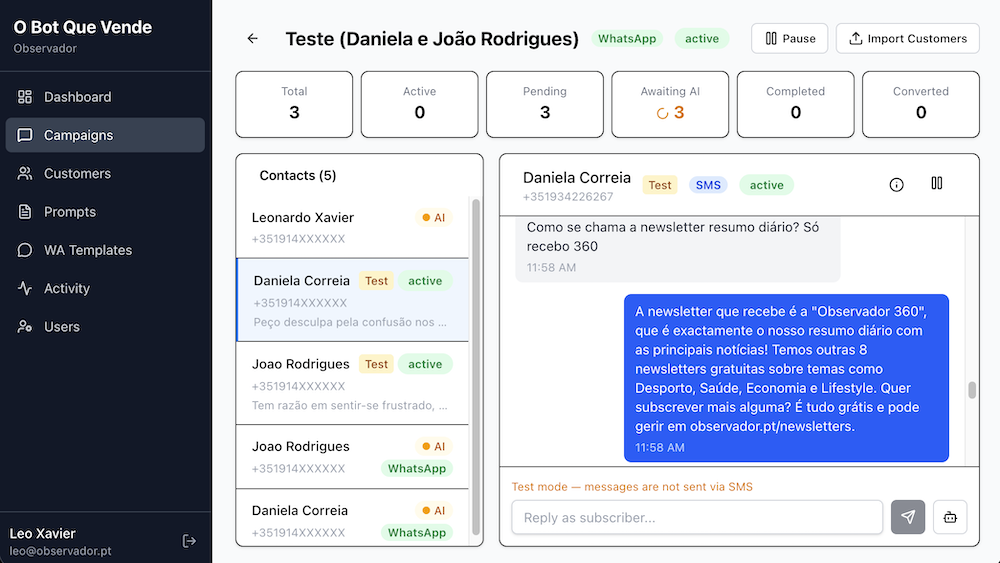
The idea is simple to describe: The Concierge reaches out one-to-one over SMS or WhatsApp, knowing the subscriber's plan, billing, reading habits and other habits. It has a real conversation about upgrading, subscribing or returning. Within editorial guardrails on tone and commercial guardrails on what it can offer, it negotiates, and it can close the transaction.
This isn't just "something humans do, but faster". A human cannot have 50,000 individual conversations. A traditional automated campaign cannot be personal. Until very recently, the Concierge simply wasn't possible, which is what makes it the right time to experiment with.
What we've done so far
We're about halfway through the programme. The first sprint was alignment: getting editorial, subscriptions, engineering and data in the same room and agreeing on what the Concierge should and shouldn't do. Miguel Pinheiro, our Editorial Director, set guardrails for how the Concierge talks about Observador and about readers' habits. Daniela Correia, our Head of Subscriptions, defined the segments, success metrics and negotiation latitude. João Rodrigues, our Head of Data, mapped what we actually know about each subscriber. João Almeida Santos, our full-stack engineer, started wiring the system to Twilio, our subs CRM, and Stripe.
By the end of the second sprint, the LLM and the messaging channel were live: we could send a personalised message to a real phone number and have the response come back into the system. The CRM and payment integrations are nearly complete. The third sprint, where we are right now, is the first real test: a 50 – 200 subscriber batch, with the team watching the conversations live and measuring what actually converts. These are the conversations that will set our baseline against the metric we care about most: how does the Concierge perform compared with our telemarketers?
What's next
Once we have that baseline, the rest of the programme is about improvement and iterations. It’s about an A/B testing system so we can compare prompts, channels, and negotiation rules without changing code. It’s also about a dashboard tracking conversion, response rate and cost per transaction KPIs. Further improvements include an operator interface so the subscriptions team can supervise and intervene without needing engineering intervention. We’re also considering autonomous triggers, like the system noticing on its own that a subscriber hit a content anniversary, or otherwise crossed a threshold worth reaching out about. Finally, we envision a larger test with 500+ subscribers, and then a full-scale run by the end of the programme.
The minimum we want to walk away with is a 5x ROI on message costs alone, and a system the subscriptions team can operate independently.
Why it matters: Looking beyond Observador
This isn't only a revenue project for us. If it works, it shifts our internal narrative stronger towards subscriptions as the engine of sustainability, and less focused on the recurring temptation to chase advertising growth. It also allows us to dip our toes into the new possibilities of extremely personalised interactions with our readers. Today it’s a subscriptions concierge, what could it be tomorrow?
_____
This article is part of a series providing updates from the second cohort of the JournalismAI Innovation Challenge, supported by the Google News Initiative. To read articles from our other grantees, click here.