
Most newsrooms don’t have an AI problem. They have a coordination problem
Lessons learnt from Strategy Lab applications for Central and Eastern Europe, and a look at the cohort now joining us

Jamillah Knowles & Digit / https://betterimagesofai.org / https://creativecommons.org/licenses/by/4.0/
Ask around a newsroom, and you will usually find that almost everyone is already using AI in some way: one reporter runs interviews through a transcription tool, another drafts headlines with a chatbot, and someone in the social team makes images with it. Ask whether the newsroom has agreed on guidelines for how any of this should be done, and the answer is usually no.
That gap between how much AI is already in use and how little of it is coordinated was the clearest thing to come out of the applications we received for the JournalismAI Strategy Lab in Central and Eastern Europe. We expected to find newsrooms asking how to get started. However, we mostly found the opposite: people who had already started, on their own, now needed a way to make sense of it altogether.
An evolved programme, and its first cohort
The Strategy Lab is an evolution of a JournalismAI programme formerly known as the JournalismAI Academy, and this is its first cohort for Central and Eastern Europe. Where our earlier training focused on getting newsrooms comfortable with the tools, the Strategy Lab is about the harder questions that come next: Where does AI belong in the work, and where does it not? How does an organisation reach that decision collectively?
Over five weeks, the cohort works through these questions in a structured way. They will look at how AI is already moving through their newsrooms, weigh up where it can really help versus where it adds risk, learn from one another and from people who have done this before, and build an action plan they can take back to their teams. The aim is not a list of tools to try. It is a clear, deliberate approach that the whole newsroom can stand behind.
Twenty journalists, editors, and newsroom leaders make up that first cohort. They come from outlets of very different sizes, from national broadcasters to two-person teams. What they share is less a gap in knowledge than a gap in coordination. A few other things stood out from reading their applications, and they are worth sharing.

The region is further along than it gets credit for
It would be easy to assume these newsrooms are catching up. Many are not. Some are well past the experimentation stage: one outlet uses AI to translate and republish its journalism across roughly twenty languages; another runs an in-house lab with dozens of tools to track disinformation, and helped write one of the first AI codes of practice in its country; a public broadcaster wrote its AI policy two years ago and is now on its second strategy.
The contrast with the coordination problem is the interesting part. Being good with the tools does not automatically produce a shared approach to them. In several of the more advanced newsrooms, AI use was still happening on a person-by-person basis, without a shared view of what the organisation does and does not want to do. Capability had outrun policy. Closing that distance is what a lot of this cohort applied to the programme to work on.
Disinformation is the common thread
In other regions where we have run earlier JournalismAI programmes, disinformation is one concern among several. Here it sits at the centre. Nearly four in ten applicants (39%) are fact-checkers or work in verification. Many described tracking organised, often state-backed influence campaigns across languages and platforms, with much of this activity amplified by AI-generated content and deepfakes and timed around elections.
That work is happening against unusually low public trust in the news. The Reuters Institute’s Digital News Report 2026, published recently, puts the global average at 37%. In Bulgaria, it is 21%, among the lowest anywhere; the report ties this to a turbulent year of anti-corruption protests and the collapse of the government, and criticism of broadcasters over their coverage, political bias, and the firing of prominent journalists.
In the Czech Republic, trust has held at around the low thirties for a couple of years; public service broadcasters remain the most trusted brands even as political actors try to chip away at their credibility. That tension is underlined by a proposed bill that would replace the licence fee with direct state funding from 2027 and cut their initial budgets. In Serbia, the report describes a media landscape that has worsened during the current political crisis. Growing state ownership and financial and political pressure on the market, and steady hostility towards independent outlets are eroding press freedom and journalists’ safety.
What was notable in the applications was the attitude to all this. These journalists and media practitioners are not asking how to keep AI out of the newsroom. They want to use it on the problem: to scan and prioritise suspicious content faster than a human team can, to catch an old fake resurfacing in a new form, and to free up fact-checkers for the verification only a person can do. The same technology making their information space harder to navigate is the one they want to push back with.
For small and exiled newsrooms, the real challenge is capacity
37% of applicants come from small newsrooms of ten people or fewer, with many operating in teams of just two or three people and relying heavily on grant funding. Another 27% represent newsrooms operating in exile, including a Belarusian outlet now working across Lithuania and Poland after being labelled an ‘extremist’ organisation in its home country. For them, the questions go beyond tools: how to reach audiences back home safely, and how to fund a newsroom whose own community cannot openly support it.
The tasks they wanted AI to take on were practical and specific. Transcribe a long interview. Translate and monitor across languages. Automate the repetitive work that returns every year; one fact-checker pointed to the annual slog through politicians' asset declarations. Turn one strong story into several formats that a small team is expected to produce. Less about reinventing the newsroom, more about buying back the time to report.
Change is happening but slowly
Not everywhere is moving at the same speed. In Poland, the Digital News Report describes online news use holding steady and traditional sources declining only gradually. AI chatbots are only beginning to appear as a way into the news, and consumption habits have changed little over the past year. The pace of adoption is uneven across the region, and in slower-moving markets like Poland, that gives newsrooms a little more time to plan.
But slower adoption does not mean fewer challenges. In Slovakia, overall trust in the news sits at around 19%, among the lowest of any market in the Digital News Report. The country has a weak public broadcaster that successive governments have wanted to use as an instrument of state messaging, and a polarised press and online sector that, for all its strain, includes some inventive business models. When trust falls this far, the report warns, imitators that mimic journalism without its standards find room to grow, which is much of what is at stake in the years ahead.
One finding from the Digital News Report is worth holding onto. Audiences who use AI chatbots for news tend to be among the most engaged news consumers, with broad, multi-platform news diets. The feature they value most is not the summary but the ability to ask a follow-up question.
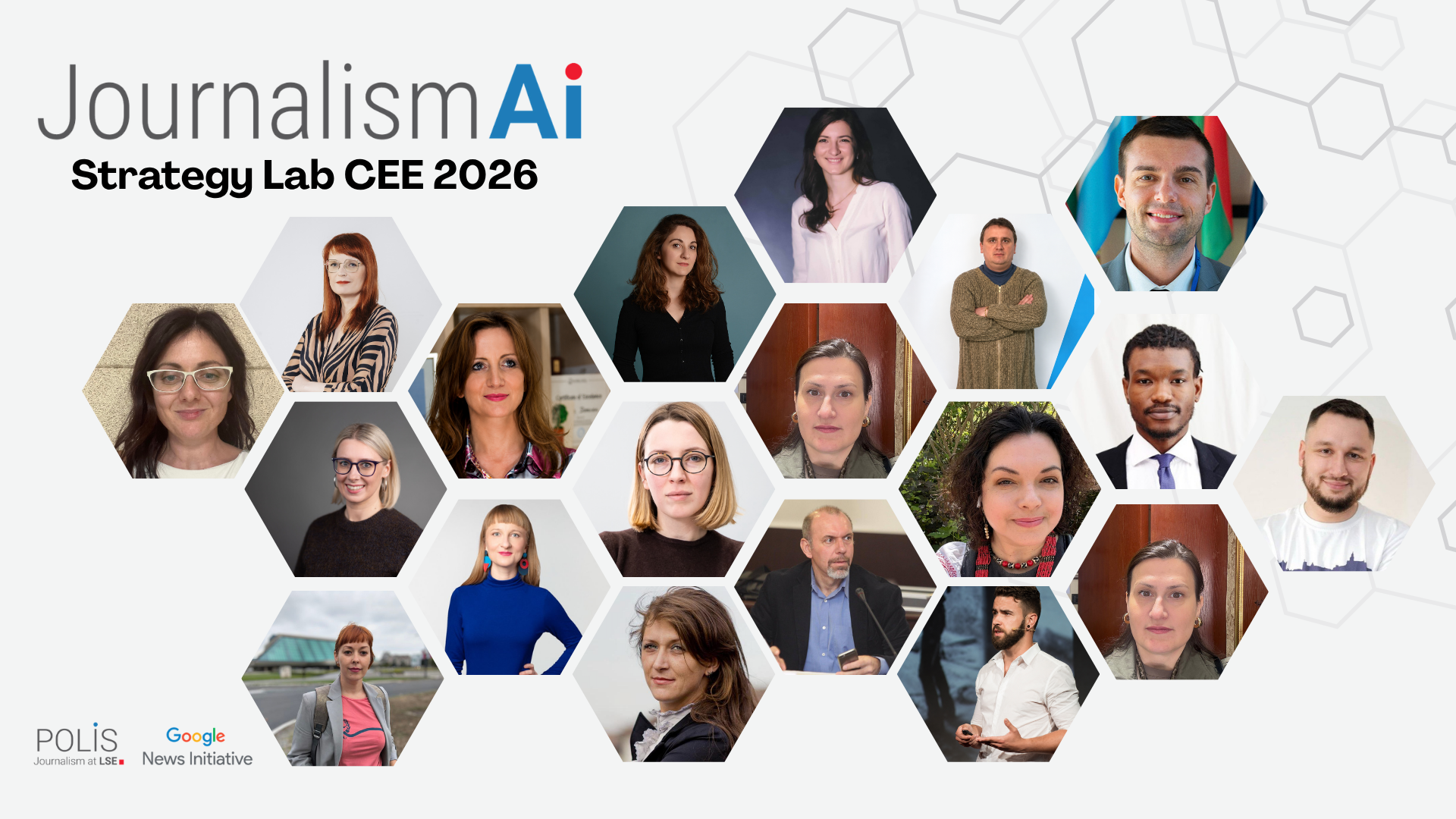
The JournalismAI Strategy Lab Central and Eastern Europe Cohort 2026
Over the next five weeks, this cohort will work through how to use AI without compromising credibility. AI can help free up time and attention for the journalism that matters most, but how it is used will shape its impact. Here is who they are.
Meet the participants
🇦🇱 Albania
Lindita Çela | Editor-in-Chief at Shteg
🇧🇦 Bosnia and Herzegovina
Azra Atagić-Ćatović | Project Manager at Akta.ba
🇧🇾Belarus (in exile)
Aliaksei Shota | Editor-in-Chief at Hrodna.life
🇧🇬 Bulgaria
Georgi Totev | Editor at FactCheck.bg
Stanimir Vaglenov | Online Projects Manager at 24 Chasa
🇨🇿 Czech Republic
Samuel Akoni | Product & Analytics Manager at Project Syndicate
🇪🇪 Estonia
Merili Nikkolo | Editor-in-Chief of Eesti Ekspress at Delfi Meedia
🇱🇹 Lithuania
Inga Dubauskienė | Front Page Manager and Foreign News Editor at Delfi.lt
🇲🇰 North Macedonia
Marta Stevkovska | Journalist and Researcher at PINA (Platform for Investigative Journalism and Analysis)
🇵🇱 Poland
Ewa Pluta | Digital Publisher at Pismo. Magazyn Opinii(Pismo Foundation)
Katarzyna Górniak | Reporter at TVN24
🇷🇴 Romania
Ana Poenariu | Journalist at Public Record
Felicia Crețu | Editorial Fact-checker at Cu Sens
🇷🇸 Serbia
Slobodan Martinović | Researcher and Editor at Centar za istraživanje u politici Argument (Argument Center for Political Research)
Aleksandra Bučko | Podcast Producer and Editor at Fabrika kreativnosti(Factory of creativity)
Irena Pejić | CEO at the Center for Applied Communication, publisher of masina.rs
Milos Katic | OSINT Project Manager at BIRN Serbia
🇺🇦 Ukraine
Anastasiia Korinovska | Editorial Product Manager at Suspilne Ukraine
Olena Churanova | Fact-checker and Editor at StopFake
Meet the instructors
Sergei Yakupov, Founder of AI for Newsroom, who has spent more than 25 years in news media and now helps newsrooms put AI and automation to practical, sustainable use. He will be teaching Module 1: AI in Practice: Concepts and Applications.
Mirko Lorenz, Innovation Manager at Deutsche Welle and co-founder of Datawrapper, is now focused on language technology, including the plainX platform. He will be teaching Module 2: Data, Tools, and Workflow.
Ole Reißmann, Director of AI at SPIEGEL Group, a journalist and media innovator working on strategy, transformation, and product, and author of the newsletter THEFUTURE. He will be teaching Module 3: Generative AI for Journalism.
Branislava Lovre, Co-founder and Editor-in-Chief of AImpactful, with two decades in media working on AI literacy and responsible AI use, was named one of the 100 Brilliant Women in AI Ethics in 2023. She will be teaching Module 4: Risks, Ethics, and Editorial Governance.
Aida Kokanovic is the founder of brAIght ApS, building AI systems for data gathering and analysis. A former OSINT specialist and data journalist, she helps newsrooms turn complex data into usable intelligence and embed AI operators into everyday workflows. She will be teaching Module 5: From Ideation to Implementation.
Follow the cohort’s progress by connecting with us on LinkedIn,BlueSky, and X.
