
Building an institutional memory of impact with an AI thought partner
Halfway through their JournalismAI Innovation Challenge project, Religion News Service’s team shares the ideas that they are exploring to capture the difference the organisation’s journalism makes, and where the work stands
By: Rocio Hernandez, Religion News Service
Every newsroom has a version of this story. A reader writes months after a piece runs, saying it helped them navigate a difficult moment. A source mentions, almost in passing, that the coverage came up in a meeting that mattered. A piece is cited in a policy debate or a legal proceeding. Each moment passes, and unless someone writes it down, it disappears.
This is not a new problem, though it carries new weight now. The ground is shifting beneath newsrooms in more ways than one, as AI changes how information reaches people, misinformation spreads more easily, and trust grows harder to earn. The case for what independent journalism offers must be made more often and more clearly.
Religion News Service has reported on faith and public life since 1934, and in all that time, we have never had a reliable way to capture the difference our work makes. When we were selected for the JournalismAI Innovation Challenge, funded by the Google News Initiative, we proposed to use AI to change that and build an institutional memory of our impact. We are one of 12 publishers chosen worldwide, and the only North American outlet, now halfway through a nine-month build.
A few ideas have guided us from the start: that a thought partner could make capturing impact feel natural rather than burdensome, that AI could bring some efficiency to that work and eventually help us find patterns we would otherwise miss, and that all of it could add up to a record the entire organisation could reference. This article is a look at how that work is progressing.
A thought partner, not another task
The reasons to pay attention to impact are simple; it tells us, and the people who support this work, that it matters. It is how a story someone reported on six months ago turns out to be part of a larger pattern. And it is what keeps a newsroom oriented toward the people it serves, rather than just the next deadline.
But it’s hard fitting this work into an industry where everyone is already stretched. So when we explored something new, we tried to be honest about that constraint from the start.
Our question has been a practical one: What happens if the place to record impact lives inside the tools we already use every day, and the act of recording feels less like filing a report and more like telling a colleague about something worth remembering? That is the bet we are making, that a thought partner in our workspace will surface more impact than a form ever could.
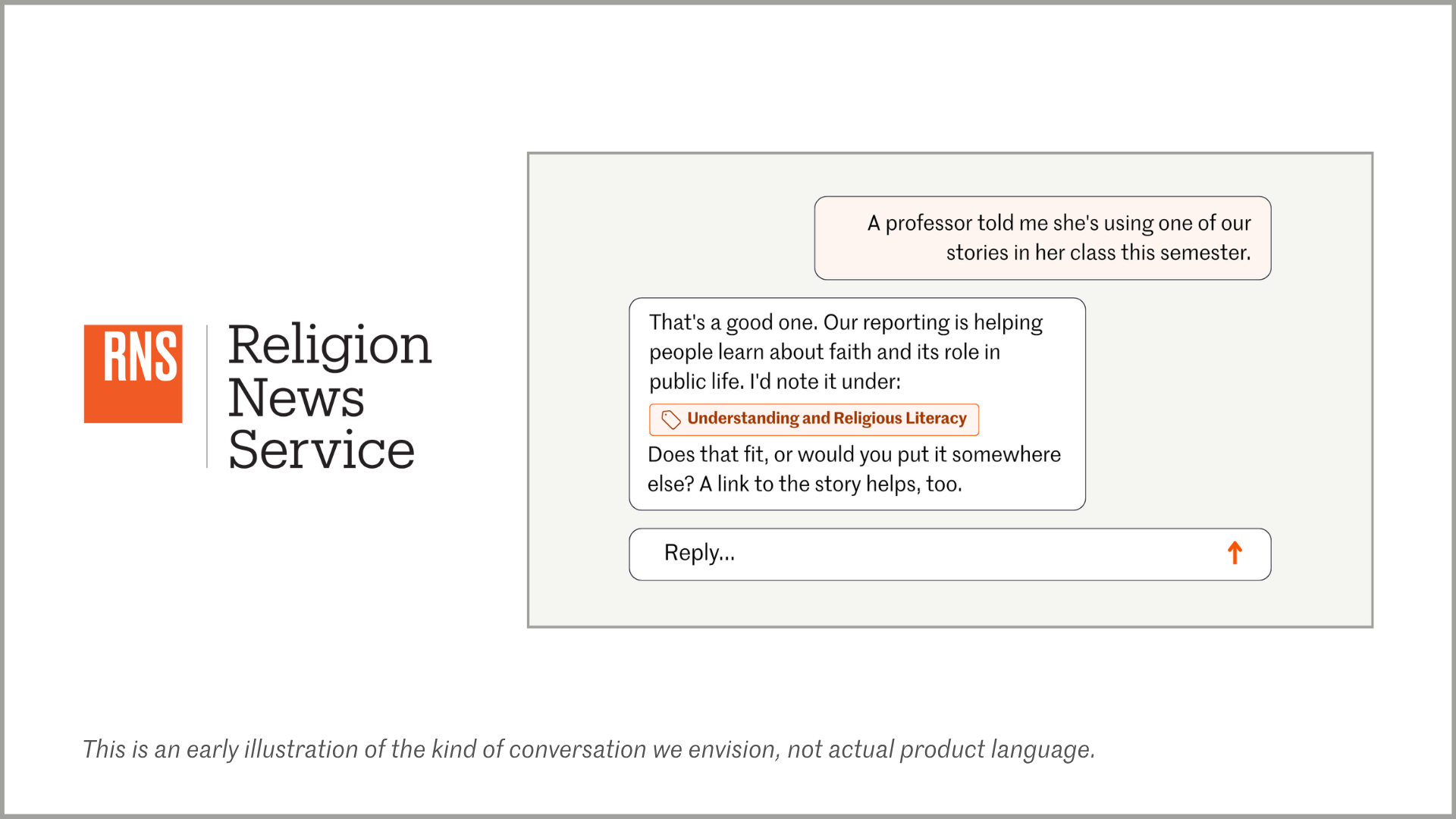
We have a working prototype of that thought partner running in Slack now, and our team is testing it, with their feedback shaping its behavior. Someone can describe a moment in their own words, or share a link to a story, and the system helps organise it from there.
Three roles for AI
We have come to think about AI as playing three roles. The first is capture, turning a short note or a link into a clear record. The prototype handles this now.
The second is enrichment, where we are testing whether AI can read what someone shares, suggest which of our five impact categories it fits into, and pull in the story's own data from our analytics tools, so that a single sentence becomes a fuller picture.
The third is insight. Our analytics manager has built an early dashboard in Data Studio that already organises impact by category. As submissions accumulate, we are exploring whether AI might read across that data and show us what we would otherwise miss. This is the piece furthest from being built, but it is the one that could turn a simple record into something the whole newsroom can learn from.
Across all three roles, the question we keep returning to is not what AI can do on its own, but what it can do with the knowledge our team already has. AI can recognise and organise the impact we describe, but it cannot create that impact out of nothing. It depends on people sharing what they have seen and heard, which is why the experience of sharing has to feel effortless.
Impact that belongs to everyone
That dependence on people sharing what they know is also why we did not want impact to be defined by any single person or department. We drafted five impact categories early on, then refined them against what we heard when we surveyed our staff and our audience, so they would reflect how the whole organisation — and the people we serve — already understand the difference we make.
One small moment told us we were onto something. A colleague who had filled out the survey came back weeks later to ask for a copy of their own response, because they wanted to use it for something else. That is the kind of memory we are trying to build.
There is value here for fundraising, but it extends beyond that. A record of impact gives our journalists something to draw on at awards time, lets us see how our coverage of a community or an issue has deepened over the years, and reminds the whole newsroom what the work is for.
Next, we’ll refine this system and ask our colleagues to poke holes in what we’ve built. By October, we plan to have a working tool and process for our team to capture impact in real time, along with an open guide that could potentially be offered to other newsrooms to adopt and help us continue growing the tool’s performance.
What works for us will look different somewhere else. But the goal beneath it has not changed since our first week, which is to make sure that when our journalism makes a difference, someone writes it down.
Impact Intelligence is a team effort at Religion News Service, with leading support from Brian Gonzales, John Greer, Rocio Hernandez, and Quentin Washington. The project began with early contributions from Tyler Borchers.
_____
This article is part of a series providing updates from the second cohort of the JournalismAI Innovation Challenge, supported by the Google News Initiative. To read articles from our other grantees, click here.