
Bridging the China coverage gap: AI-powered news monitoring
Afore Hsieh is a Taiwan-based producer for the Canadian Broadcasting Corporation. Discover how the JournalismAI Skills Lab helped her build an AI-powered news monitoring tool for China

Covering China from Taiwan presented a unique challenge for Afore Hsieh, a Taiwan-based producer for CBC. As a fixer working with a CBC journalist on the French-language service, she found herself struggling to understand what was truly happening on the ground in China. While major news events were easy to track, the softer stories – youth unemployment trends, emerging social phenomena, everyday concerns of ordinary citizens – remained elusive.
"Those are the stories that you have to be in China for, talk to people, and learn," Hsieh explains. "But because we're not there, it's hard for us to do any of that."
She decided to tackle this problem with the help of the JournalismAI Skills Lab, a programme supported by the Google News Initiative.

The solution
Hsieh initially hoped to scrape Xiaohongshu (Red Note), a popular Chinese social media platform that is rich in authentic user content. However, lacking technical expertise and facing the platform's anti-scraping measures, she hit a wall before the programme even began.
The breakthrough came through persistence and flexibility. After joining the JournalismAI Skills Lab, Hsieh discovered that Baidu – China's dominant search engine – offered a free API for its trending topics list. While not as granular as Red Note's user-generated content, it provided a workable alternative for monitoring what was capturing Chinese internet users' attention.
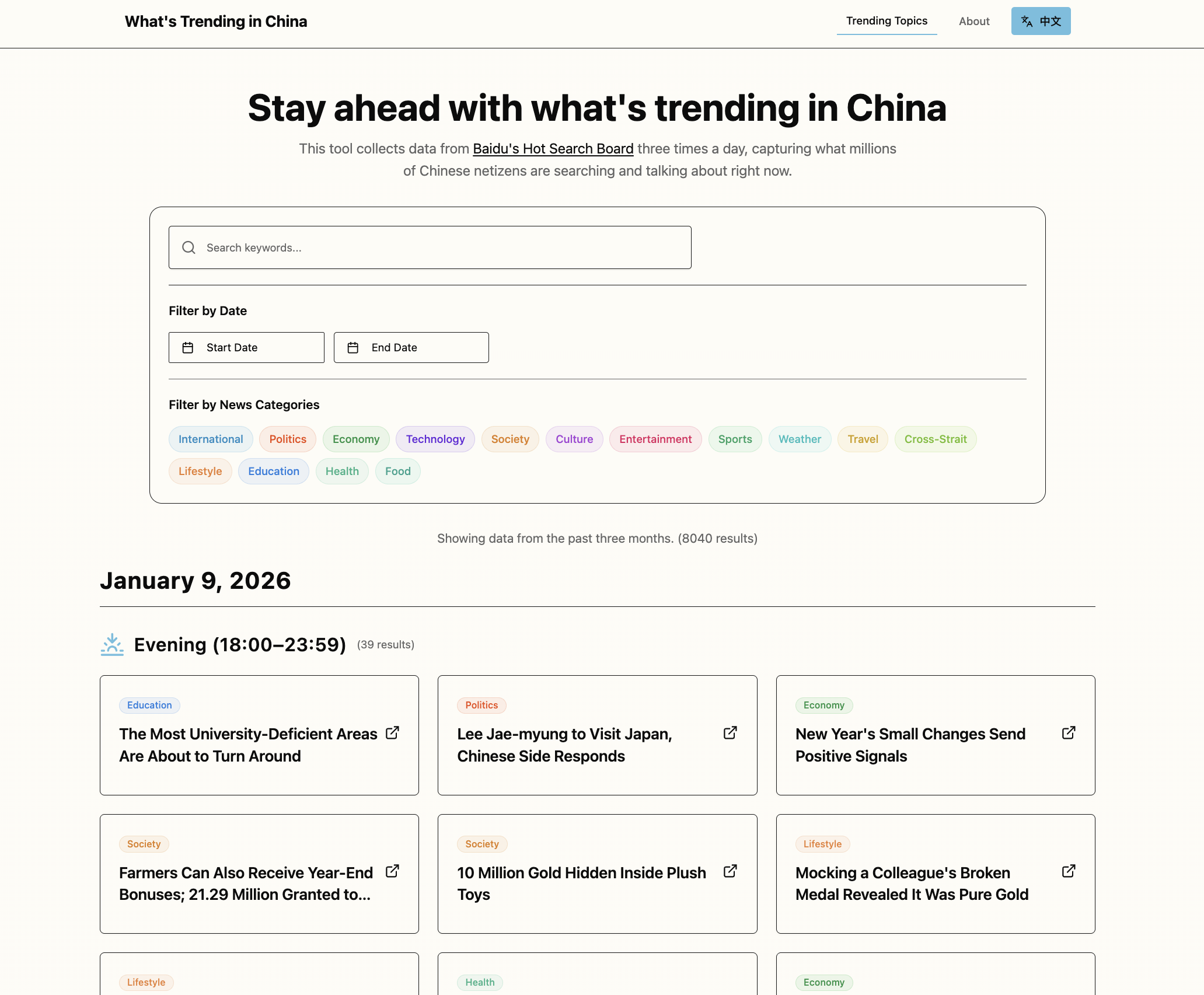
Dashboard of Hsieh’s tool
Working essentially as a two-person team with another CBC colleague, Hsieh built a data collection tool using a combination of technologies: Supabase for the backend, Lovable for the frontend. This included various other components that she admits she sometimes used without fully understanding as she vibe-coded her way through this newly discovered territory.
The project remains focused on China coverage for now, though Hsieh has shared it with her CBC colleague and plans to present it to the broadcaster's AI consultant for potential wider implementation.
Key takeaways
Foundational knowledge matters, even in the age of vibe-coding. Hsieh estimates that 90-95% of her code was generated through AI assistance. Yet the basic Python training proved invaluable. "If I didn't have those fundamentals, I would just know it's not working, but I wouldn't know what's wrong and how to fix it," she reflects. Understanding the basics enabled her to communicate effectively with AI tools and troubleshoot problems.
Structure and accountability drive progress. Before the Skills Lab programme, Hsieh had attempted to build projects independently using no-code tools but abandoned them after a week, lacking motivation and support. The combination of regular deadlines, one-on-one consultation sessions, and a supportive cohort transformed her approach. "I really pushed myself – I spent hours, days trying to build it."
Reverse-engineering existing projects builds confidence. One of the weekly Skills Lab sessions particularly resonated with Hsieh: examining successful AI journalism projects and analysing how they were built. "Those projects look really amazing on the outside, but many of them aren't so technically complicated to build," Hsieh discovered. Understanding the architecture behind impressive tools made future projects feel achievable.
Hsieh's confidence in developing AI solutions jumped from 10 out of 100 before the programme to 85 afterwards. Her message to fellow journalists: "If I, as a non-tech person, can do it, I believe every journalist can do it."
Other JournalismAI Skills Lab Case Studies
Cutting through healthcare data complexity: An AI-powered research tool
From fine-tuning to smart prompting: Automating routine news at ANKA
From intuition to intelligence: Building a data-driven newsroom tool
Tackling dirty data: Building an AI-powered metadata classification tool
Gaming the censors: A new way to tell China’s untold stories
Putting Taiwan's company financials at reporters' fingertips
