
Cutting through healthcare data complexity: An AI-powered research tool
Niels van Nimwegen is an investigative reporter at Pointer, part of the Dutch public broadcaster KRO-NCRV. Learn how the JournalismAI Skills Lab helped him build a RAG-based tool to navigate fragmented healthcare data

Jamillah Knowles & Digit / Better Images of AI / CC BY 4.0
Investigating healthcare fraud in the Netherlands requires navigating an unusually complex landscape. The Dutch healthcare system – largely privatised yet heavily regulated – is vulnerable to bad actors, making it a flagship theme for Pointer's investigative journalism team. However, proving fraud demands synthesising data from multiple regulators, each maintaining their own datasets in different formats: PDFs, massive open data files, inspection reports, financial records, and personnel information.
"It's really difficult to prove fraud and you need a lot of different steps," explains Niels van Nimwegen, who has been a reporter for over two decades. "Every regulator has their own way of maintaining these datasets. Some as PDF, some as massive open data files which are not easy to parse – and especially not easy to combine."
The challenge is compounded by Pointer's structure as a team of generalists. Unlike larger newsrooms with dedicated healthcare beats, at Pointer, anyone with room in their schedule might work on healthcare stories. This meant you cannot assume specialised technical knowledge.

The solution
With the help of the JournalismAI Skills Lab, a programme supported by the Google News Initiative, Van Nimwegen set out to build a RAG (Retrieval-Augmented Generation) framework that could make multi-source healthcare data accessible to journalists without specialised Python or R skills. Using Claude Code and Cursor, he developed a tool that enables quick lookups across fragmented datasets, transforming what previously required technical expertise into something approaching a conversational interface.
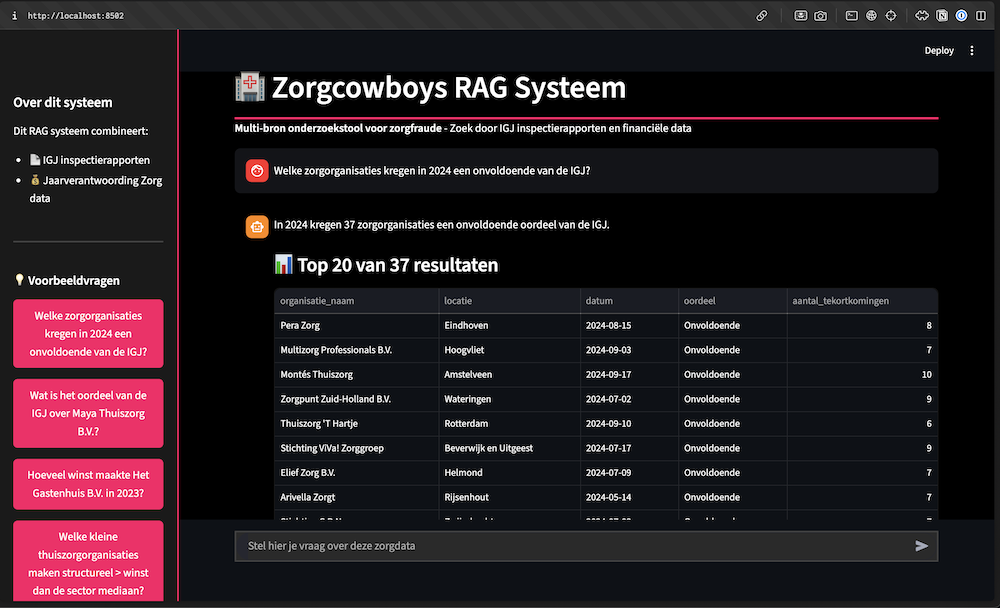
Dashboard of Van Nimwegen’s RAG-based tool, Zorgcowboys
The project emerged from three converging motivations: Van Nimwegen's growing personal engagement with AI, his newsroom's need to scope out where AI could add genuine value to investigative workflows, and his own interest in transitioning toward a more hybrid role combining journalism with technical development.
Initial testing with colleagues has been warmly received, and Van Nimwegen plans to iterate further. A version two is in development, aiming for a more free-flowing experience resembling ChatGPT but with custom tooling and access to proprietary datasets. The tool may also support collaborative work with regional journalists, providing them with "reporting recipes" and leads to pursue independently.
Key takeaways
Learn Python fundamentals, even in the age of AI coding assistants. Van Nimwegen used AI tools to generate most of his code, but emphasises that understanding scripting logic was essential. "You still need to understand what's going on under the hood, otherwise you're going to be off on some kind of trail you don't want to be on." One of Skills Lab's modules, “fundamentals”, proved indispensable for following script logic and debugging effectively.
Scope your project thoroughly before building. Taking time to define the problem space and technical requirements in detail prevented wasted effort. Clear scoping helped Van Nimwegen make architectural decisions that aligned with actual newsroom needs rather than assumed ones.
Test assumptions with end users early and often. When Van Nimwegen asked colleagues to submit example questions they would want to ask the tool, the responses were "completely different in nature" than anticipated – more exploratory and open-ended rather than narrowly focused on specific organisations. This feedback fundamentally shaped the tool's architecture. Regular user testing prevents building solutions to the wrong problems.
Other JournalismAI Skills Lab Case Studies
From fine-tuning to smart prompting: Automating routine news at ANKA
From intuition to intelligence: Building a data-driven newsroom tool
Tackling dirty data: Building an AI-powered metadata classification tool
Gaming the censors: A new way to tell China’s untold stories
Putting Taiwan's company financials at reporters' fingertips