
When newsrooms build AI tools, where does the money actually go?
We analysed financial reports of 32 publishers to understand how they spend funding when building AI tools

Picture: Photo by Jakub Żerdzicki on Unsplash
When newsrooms build AI tools, how do they allocate the funds for the project? We unpack findings from the first cohort of the JournalismAI Innovation Challenge, supported by the Google News Initiative programme on how they’ve used funds, highlighting the friction points of implementation, and share some fiscal best practices for future innovation.
Between December 2024 up until October 2025, we tasked 35 news organisations from 22 countries to experiment with building new AI solutions for their respective newsrooms and communities. We gave 10 of those organisations $250,000 while the remaining 25 received $50,000 for this work. At the end of the programme they were required to submit a final financial report, with supporting evidence showing how they spent their funding. We analysed 32 of these reports on how they allocated funds during the programme.
The data reveals that AI spending isn't just about buying technology – it is a complex mix of specialised talent, infrastructure, and subscription services. The primary cost driver, 65% of the budget, for most publishers was on the human talent required to build and manage these tools. Across the publishers, budget lines for full-time staff or consultants and part-time specialists consistently outweighed software licensing. This is followed by 20% of the budget spent on technology, ranging from the servers and hosting required to run them, to the direct costs of intelligence such as API tokens and model credits. The remaining 15% of the budget was allocated to operations and administrative costs.
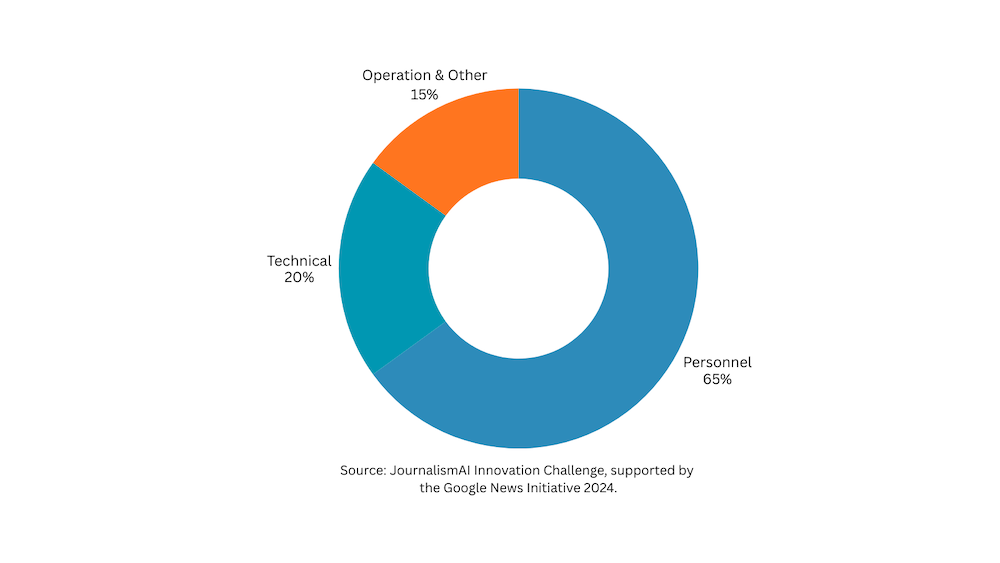
Chart showing aggregate budget breakdown from 32 publishers on the Innovation Challenge.
Who builds the tools?
Contrary to the idea that AI replaces people, building AI tools is incredibly labor intensive. The builders of these tools were a combination of AI champions, specialists, and supporting staff. The core group consisted mainly of a project manager, data journalists and full stack developers.
Depending on the type of tool that your newsroom is working on, the specialists could range from prompt engineers to AI interaction designers or legal researchers. The budgets revealed that many of the publishers utilised part-time staff or consultants to plug specific high-cost skill gaps where for example, there was a need for a data scientist or LLM specialist, rather than making full-time hires. Some publishers collaborated with tech startups or university computer science departments.
Support staff were also project- or tool-specific, but not dedicated specialists. For many of these publishers, localisation of tools and platforms matters. These support roles could be anything from fact-checking annotators to language testers – a high cost of creating bespoke datasets for AI models where they don’t exist. Because AI models natively support major Western languages better than others, publishers in Nigeria spent a significant amount of their budget training AI on model Nigerian accent. Other publishers in Africa and Latin America had to manually collect and/or build data sets in local languages.

Tech spending
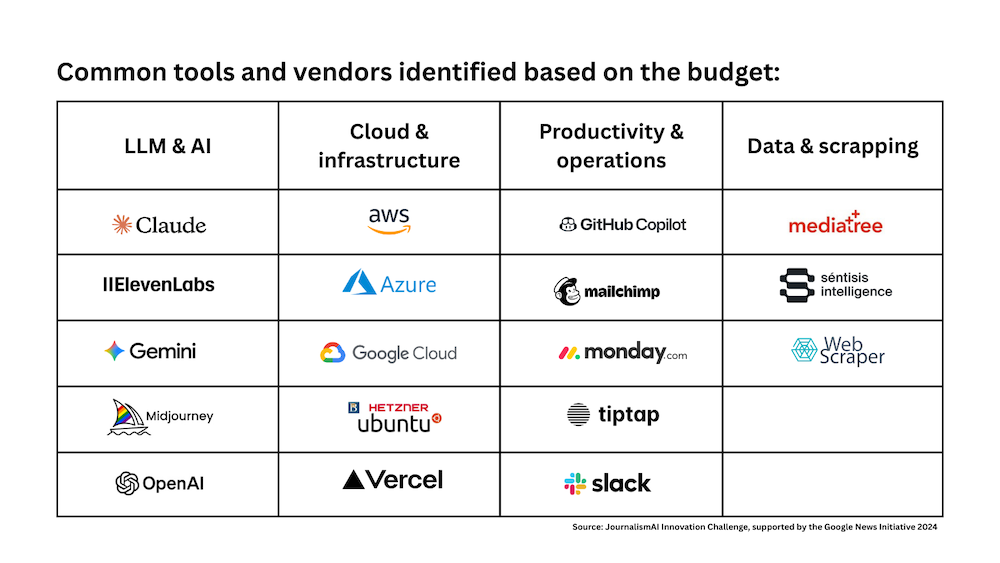
The second major pillar is the technical development required to host and deploy the tools the publishers were building. Publishers purchased high-performance laptops/computers. They spent funds on servers and hosting, with Amazon Web Services (AWS) being the standard across publishers, appearing frequently for storage and general computing needs. For projects doing heavy data processing, we saw specific investments in Google Cloud Platform (GCP) and Vertex AI, as well as Azure server clusters.
We saw standard budget lines for OpenAI, Claude (Anthropic), and Gemini access. We also saw licenses for GitHub Copilot to speed up coding, Figma for designing user interfaces, and WebScraper tools to gather the training data required for their models.
The “hidden” friction of innovation
The cost of doing business involved battling economic volatility in general, but more so in 2025. Having completed their project scoping and finalised their budgets in 2025, the industry hadn’t anticipated the ripple effects and impacts of funding cuts in/from the US and other major donors. Many outlets, including some on the Innovation Challenge had to severely reduce operations and layoff staff.
We know that AI implementation is not a monolithic exercise and it differs across regions, countries and even newsrooms. So, when we drill down the numbers to the regional level, the patterns differ ever so slightly.
Publishers in Latin America focused on resourcefulness due to severe economic instability, community engagements, and navigating high inflation. With foundational infrastructure already in place, publishers in Europe and the UK focused their budgets on high-level infrastructure and specialised engineering talent. In Africa and Asia, publishers focused heavily on establishing basic hardware infrastructure and adapting AI to local languages and communities, because they lacked the setup that European publishers already possessed.
Publishers in countries like Argentina, Nigeria, Paraguay and Brazil faced significant purchasing power fluctuations. The budget line increased solely due to weakening local currencies. Tied to this were transfer fees. Significant portions of the publisher’s budgets were lost to international wire fees and bank charges. For example, inflation forced a 700% salary adjustment for one publisher in Argentina; there was a variance in hardware costs due to the Naira shifts for publishers in Nigeria; while for some publishers in Europe the rate of exchange swings affected the realised funding value.
In some countries publishers were faced with basic operational challenges, like portions of their budgets having to cover diesel and electricity costs to ensure uptime for development teams. Another challenge for these small and medium-sized publishers was the hiring gap many of them faced. Finding niche talent like AI Leads or specialist roles took longer than anticipated. The result was publishers having to compress development timelines within a short period of time.
What have we learnt from these 32 publishers?
The key lesson, solely based on their financial reports, is that the biggest investment is people, not processors. If your news organisation is starting out on their AI journey, remember that personnel costs will be the dominant line item in your budget. To manage this, adopt a “consultant-first” strategy in your organisation, where you use high-level consultants to bootstrap before hiring full-time.
Because many of the tools and platforms used to aid the building of the publisher’s tools are mainly created in global north regions, countries in the global majority need to plan for friction when purchasing these tools. Consider a friction buffer in your budget for exchange rate costs, bank fees, and even hiring delays. And also mitigate inflation risks (I know, easier said than done).
An important reminder is that innovation is not linear. As you build your tool, stay flexible. Have the ability to pivot when you hit a stumbling block. Have the ability to reallocate funds where necessary.
Remember that a tool is only as good as its users. Building it is just the beginning. Fostering organisational buy-in and investing in internal promotion are what will actually get you across the finish line.
———
The JournalismAI Innovation Challenge, supported by the Google News Initiative is a programme of funding for projects from a wide range of news publishers to foster AI literacy and implementation through targeted innovation and experimentation. Read about the inaugural 2024 cohort projects in this report and watch this video about the programme. And learn more about the current 2025 cohort here.