
From fine-tuning to smart prompting: Automating routine news at ANKA
Narin Diri is a journalist at ANKA News Agency in Turkey, focusing on diplomatic coverage. Learn how the JournalismAI Skills Lab helped her develop an AI workflow that transformed how her newsroom handles municipal press releases
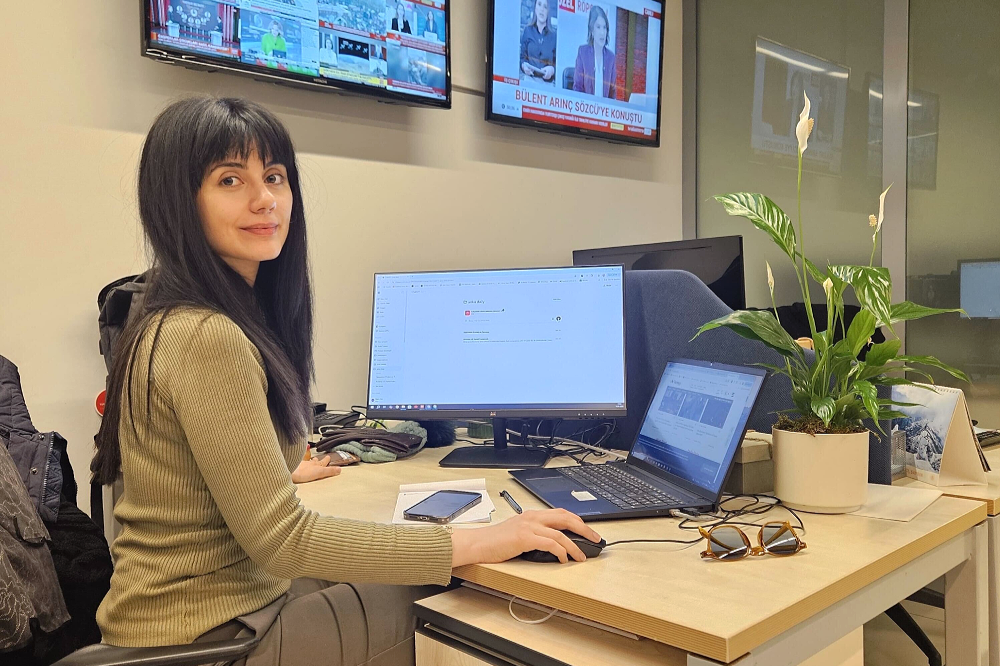
Narin Diri at her news desk
At ANKA News Agency, one of Turkey's four news agencies, a familiar problem was consuming valuable resources. Five staff members – three reporters and two editors – were spending their entire eight-hour shifts transforming municipal press releases into publishable news drafts. It was necessary work, but it left little time for the journalism that truly mattered: exclusive stories, deeper analysis, original reporting.
"Because of routine stories, we usually don't have time to focus on something genuine," explains Narin Diri, who covers diplomatic news for the agency. "Something different than what we see on social media, something that contains deeper knowledge."
She turned to the JournalismAI Skills Lab, a programme supported by the Google News Initiative, to tackle this problem.

The solution
Diri initially believed the answer lay in fine-tuning a custom AI model to match Anka's house style. It seemed like the sophisticated approach the task demanded. But consultations with Skills Lab instructors revealed a simpler path.
"I thought prompting would be too primitive, too easy," Diri recalls. "I thought for a better outcome, I needed to do it the hard way. But this programme helped me understand it's not always about making things difficult."
The final solution uses ChatGPT's Projects feature, which retains prompts and context across sessions. Reporters now process municipal bulletins through carefully crafted prompts that produce drafts in Anka's writing style. The prompts evolve daily as the team refines them based on outcomes. Diri has also begun applying the technique to the agency's newly launched English service.
Changing newsroom culture
Perhaps the most significant outcome wasn't the tool itself, but its effect on the newsroom. Before the programme, journalists who used AI did so quietly, almost secretly. Older colleagues viewed AI-generated drafts with suspicion.
The Skills Lab's professional framework helped shift perceptions. "When they saw that, if prompted properly, how consistent, fast and helpful the drafts were, they became much more open to using AI," Diri observes. “Now, no one is ashamed of using AI."
The cultural shift became tangible when one reporter argued with an editor about being stuck on routine work instead of pursuing an exclusive story. "She was saying, 'Narin is working on a project that can transform news bulletins in a very easy way. It's just robot work – why are we still losing time on it?'"
Diri sees broad applicability across Turkey's shrinking media landscape, where newsrooms operate with increasingly limited staff. "If used properly, it can help journalists actually improve their journalistic work," she suggests.
Key takeaways
Simpler solutions often work best. The instinct to pursue complex technical approaches – like fine-tuning – can obscure more practical alternatives. Understanding which methods suit which scenarios is more valuable than defaulting to sophistication.
AI literacy enables prediction. Beyond the immediate project, Diri gained the ability to anticipate how automation will reshape journalism. "Now I can make predictions about how the media industry will look in five years, which parts of journalism will be automated most. It gives me an advantage to shape my career plans."
Networks provide lasting confidence. The cohort of 20 journalists from around the world created a support system that extends beyond the programme. "If you face a problem regarding using AI in the newsroom, you have people to talk about it with. This goes a long way.”
For Diri, the JournalismAI Skills Lab programme delivered something more fundamental than a workflow: "It gave me a way of thinking about the future of journalism."
Other JournalismAI Skills Lab Case Studies
Cutting through healthcare data complexity: An AI-powered research tool
From intuition to intelligence: Building a data-driven newsroom tool
Tackling dirty data: Building an AI-powered metadata classification tool
Gaming the censors: A new way to tell China’s untold stories
Putting Taiwan's company financials at reporters' fingertips
