Introducing the Latin America cohort of the JournalismAI Strategy Lab
The Strategy Lab asks where AI fits in a newsroom's work, and where it doesn't. Twenty participants from eleven countries in Latam will work through it together; here's what we learned, and who they are.
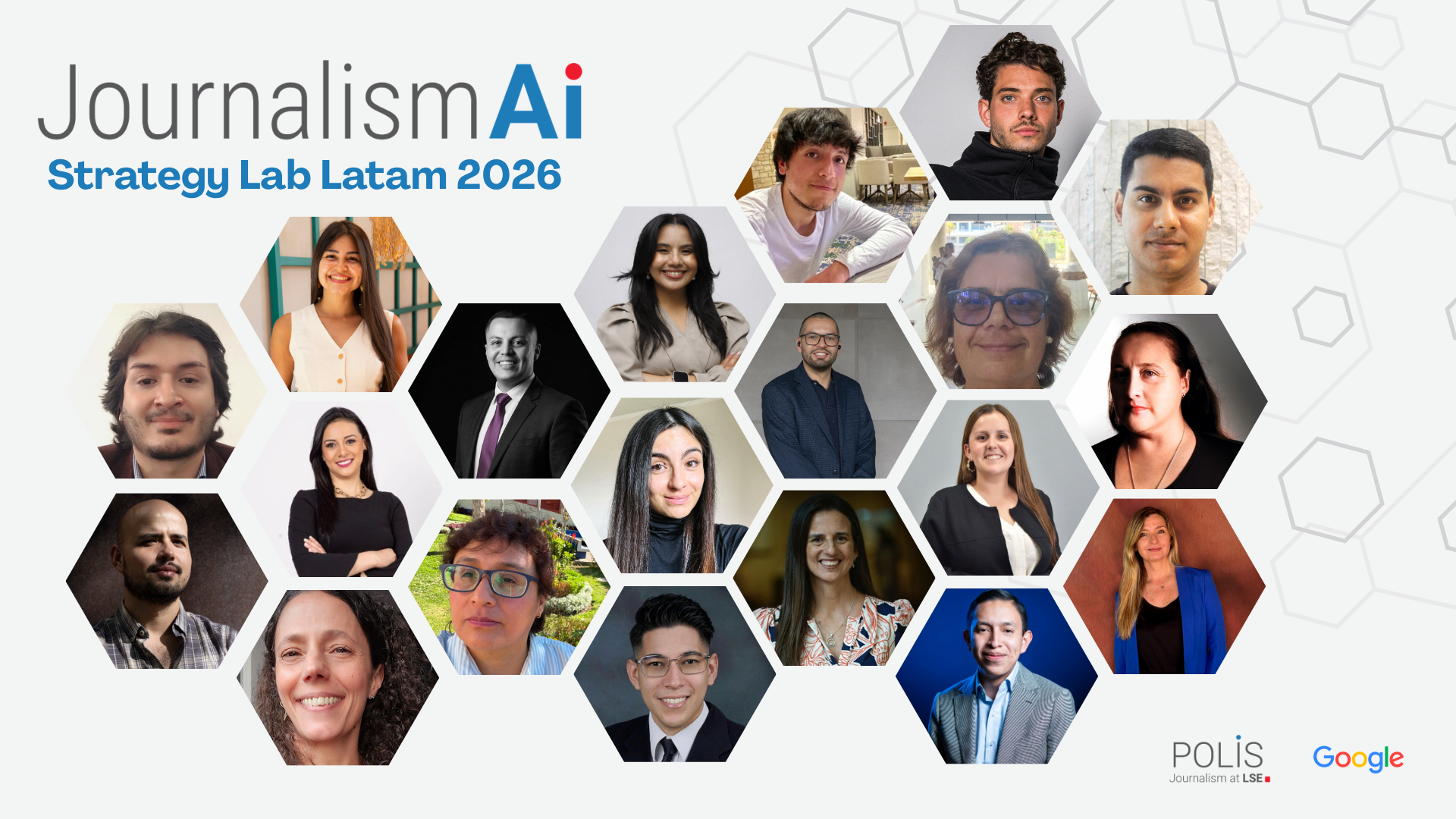
The JournalismAI Strategy Lab Latin America Cohort 2026
This year, journalists, newsroom leaders, and technologists applied to join the Latin American cohort of the JournalismAI Strategy Lab. While the applications are by no means a representative study of how the region views AI, they gave us a useful sense of their priorities, concerns, and aspirations. A few themes stood out.
The first concern was visibility. Many applicants described the growing difficulty of reaching audiences directly as readers increasingly encounter news through social platforms, video, and AI-generated answers.
For some, this was framed as an immediate rather than a distant concern. Aspen Digital's report on AI and the future of news in Latin America points to the same pressure: chatbots take on more of the work of delivering news, and the reporting that distinguishes a newsroom must work harder to be found.
The second concern was on the terms on which AI is used. Among those who applied, more than 80% reported that their newsroom already uses AI in some form, and several are well beyond experimentation, building their own tools, running data projects, or applying AI in investigations.
For most, the gap was not a lack of skills but a lack of a shared approach: AI was being adopted person by person, without an agreed position on what the newsroom will and will not do. Asked whether they had a formal AI policy, applicants reported a range of situations: about 24% had a formal policy in place, 35% had none at all, and the largest group fell somewhere in between.
The third concern was time. Many applicants wrote about the volume of repetitive work that eats into reporting: transcribing interviews, translating copy, monitoring sources, summarising long documents, combing through the same public records year after year. For a lot of them, the appeal of AI wasn't reinventing the newsroom but buying back hours for the journalism only humans can do.
A fourth concern was verification. 56% of the applicants raised the difficulty of checking claims quickly, spotting manipulated media, and keeping up with AI-generated content and deepfakes that spread faster than a small team can debunk them. Several saw this as both a threat and, handled carefully, a place where AI might help.
The applications came from markedly different kinds of newsrooms, which was part of what made the selection process difficult. Some were one- or two-person operations; others were national outlets with sizeable teams.
A number came from journalists working under considerable pressure, including those covering countries in crisis or reporting from exile. We were able to select only 20, and we are grateful to everyone who applied.
Over the coming weeks, the Strategy Lab cohort will examine where AI belongs in their work and where it does not, and how each newsroom might decide that as a team rather than leaving it to individuals.
Across five weeks, participants assess how AI already moves through their organisations, weigh where it helps against where it introduces risk, learn from newsrooms that have done this before, and develop a plan to take back to their own. Meet the newsrooms joining this year's cohort.
Meet the participants
🇦🇷 Argentina
Jimena Laclau | Top 30 Content Manager at MDZ
Maximiliano Mendoza | Director at Refugio Latinoamericano
Paola Piquer | Editorial Manager at Grupo América Interior
Pedro Greco| Editor at Revista Anfibia
🇨🇱 Chile
Banessa Blanco Arrué | Newspaper Editor at Canal 13 / T13
🇨🇴 Colombia
David Luna | Manager and Journalist at Proclama del Pacífico
🇨🇷 Costa Rica
Johel Solano Castillo | Deputy Editorial Director at Grupo Extra
🇪🇨 Ecuador
Gabriela Castillo | Journalist at Periodismo Público
Claudia Roura Cadena | Director of Digital Content at Ecuavisa
🇨🇺 Cuba (in exile)
Dario Alejandro Escobar | Journalist at La Joven Cuba
🇬🇹 Guatemala
Gérman Vinicio Gómez Barrera | Investigative and Data Journalist at República
🇭🇳 Honduras
Cesia Fernanda Paguada Núñez | SEO Analyst at Grupo OPSA
Natán Mahalaleel Márquez Flores | Editor-in-Chief at Diario Tiempo
🇲🇽 Mexico
Manuel Alejandro Castro Flores | Editor at La Voz de Guanacaste
Rey Frasua Esquerra Niño | Data Journalist and Fact-checker at Animal Político
🇵🇾 Paraguay
Analia Soledad López Caballero | Founder at Paraguay Data
🇵🇪 Peru
Rosario Romaní Díaz | General Editor at Infopais
🇺🇾 Uruguay
Deborah Friedmann | Editorial Coordinator at El País
Mandy Barrios | Audience and Subscriptions Editor at Búsqueda
🇻🇪 Venezuela
Thairy Coromoto Baute Zerpa | Coordinator and Editor at La Patilla
Congratulations to all 20 participants. We look forward to the work ahead.
Meet the instructors
Claudia Báez is the Regional Director, Latin America, at Fathm, leading AI and media innovation programmes across the region. Báez is an award-winning journalist, digital strategist, and co-founder of Cuestión Pública. She will teach Module 1: AI in Practice: Concepts & Applications.
Delfina Arambillet is an AI strategy consultant specialising in media and journalism. She leads the Responsible AI practice at Globant and co-founded the AI initiative at LN Data at LA NACIÓN. She will teach Module 2: Data, Tools and Workflows.
Karen De la Hoz leads the AI Lab at La Silla Vacía, Colombia’s leading digital political journalism outlet. She is also a professor at the University of Cartagena and a fellow of SembraMedia, ICFJ, JournalismAI, and News Product Alliance. She will lead Module 3: Generative AI for Journalism.
Olalla Novoa Ojea is Director of Artificial Intelligence at PRISA Media. A journalist by training, she worked at The Wall Street Journal and El Mundo before moving into product development, specialising in audio and AI initiatives at PRISA Media.
Gonzalo Teubal Rodriguez currently leads AI Governance at PRISA Media and is a media executive with 25+ years of experience in audience strategy, digital transformation and AI governance across leading Spanish-language media brands.
Teubal Rodríguez and Nova Ojea will co-lead Module 4: Risks, Ethics & Editorial Governance.
Sebastián Auyanet, Head of Product and AI Initiatives at Factchequeado and a consultant with over 20 years of journalism experience, supporting media organisations across the Americas and Europe. He will lead Module 5: From Ideation to Implementation.